
Introduction
You already know you need help managing HR. Payroll is eating up hours you do not have, benefits enrollment is a headache, and the compliance landscape seems to add a new layer of complexity every quarter. So you search for solutions, and two acronyms keep showing up: PEO and HRO.
Most business owners assume they mean the same thing. They do not. Choosing the wrong model can cost you more money, leave you exposed to compliance risk, and create more administrative work, not less.
This guide breaks down the real differences between a Professional Employer Organization (PEO) and HR Outsourcing (HRO), explains what each model delivers in 2026, and helps you decide which one actually fits where your business is today and where it is going.
For a deeper foundation on what a PEO is and how it functions, visit the Wise PEO pillar article: What is a PEO and How Does It Work?
What Are PEO and HRO? A Plain-English Explanation
Let us start with the basics, because the terminology matters.
Professional Employer Organization (PEO)
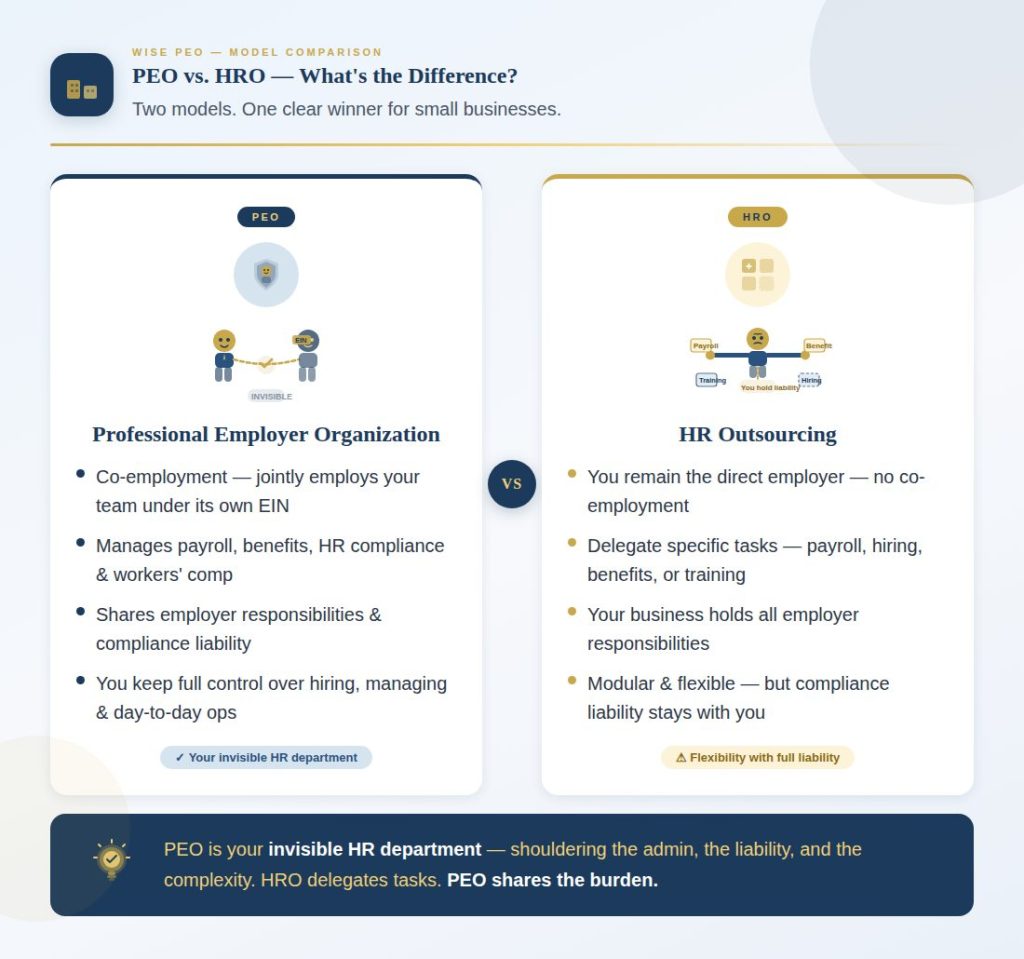
A PEO enters into a co-employment relationship with your business. That means your employees are jointly employed by both you and the PEO. The PEO manages payroll using its own Employer Identification Number (EIN), handles benefits, ensures HR compliance, and takes on some of the employer’s responsibilities. You keep complete control over how things run day-to-day, including hiring and all aspects of your business.
Consider the PEO as your invisible HR department, shouldering both the administrative tasks and a significant portion of the legal and compliance burden.
HR Outsourcing (HRO)
When you choose HRO, your company stays the direct employer. You delegate certain HR tasks like payroll, hiring, managing benefits, or training to an external firm. While the HRO takes care of the day-to-day work, your business still holds all the employer responsibilities.
HRO is modular. You pick what to outsource and what to keep in-house. That flexibility is its biggest strength, and also its most significant limitation for smaller businesses.
Why the PEO vs. HRO Decision Matters More Than Ever in 2026
The stakes of getting this choice wrong have risen considerably. Here is what has changed in the 2026 employment landscape that makes this decision critical.
• The FLSA salary threshold for exempt employees was updated in 2025 and takes full effect in 2026. Misclassifying workers under the new thresholds carries significant financial penalties. PEOs track and implement these changes automatically. With HRO, your team must stay current and act accordingly.
• ACA employer mandate reporting requirements continue to tighten. Businesses with 50 or more full-time equivalent employees face strict 1094-C and 1095-C reporting obligations. A PEO integrates ACA compliance into its core service. With HRO, you are managing this separately.
• Multi-state employment has become the norm for remote and hybrid teams. Each state brings its own tax rules, leave laws, and registration requirements. PEOs are built to manage multi-state complexity. HRO providers vary widely in their multi-state capabilities.
• I-9 and E-Verify compliance is under increased federal scrutiny in 2026. Errors in employment verification can result in audits and fines. A PEO monitors and enforces these protocols as part of the co-employment relationship.
In short, the regulatory environment in 2026 rewards businesses that have expert compliance infrastructure baked in, not bolted on. That is a structural advantage the PEO model delivers by design.
How Wise PEO’s Co-Employment Model Gives You a Structural Advantage
We operate as a trusted PEO, meaning its co-employment relationships carry a higher level of credibility, financial accountability, and compliance rigor than many HRO arrangements.
Full-Service HR Under One Roof
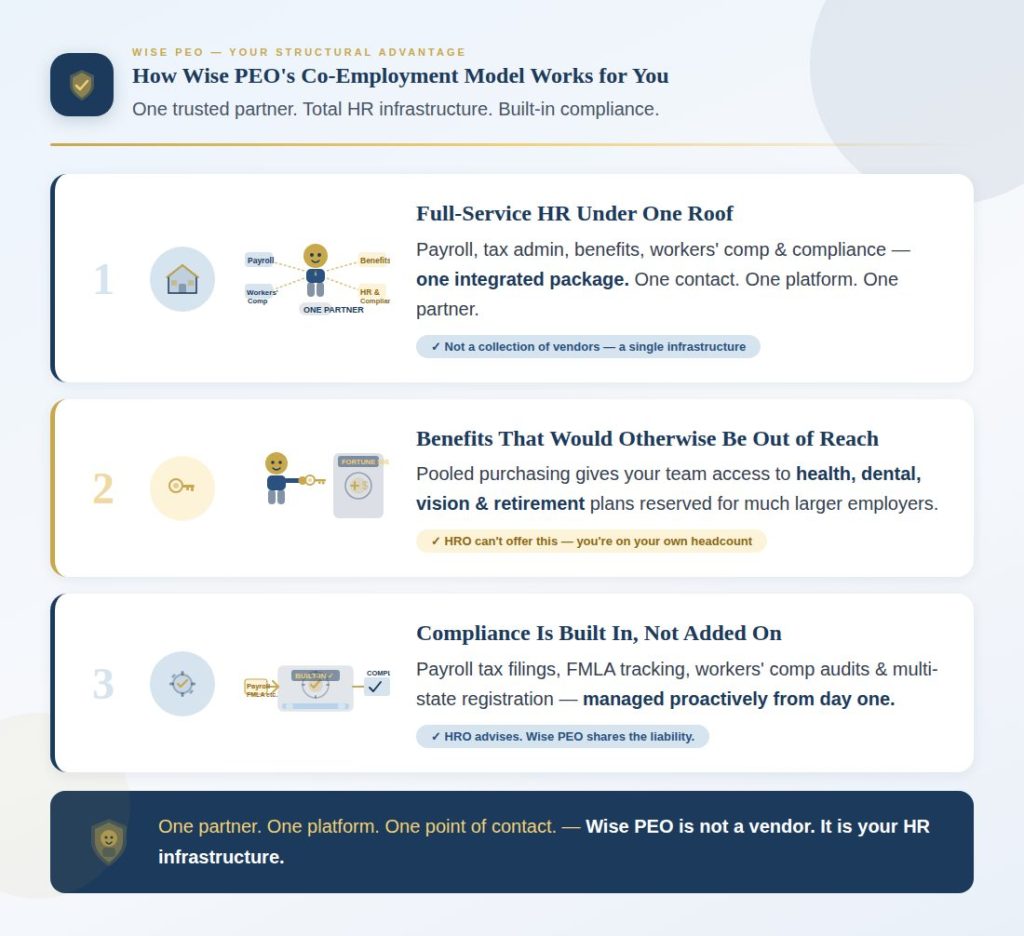
When you partner with Wise PEO, you are not picking and choosing modules. You get payroll processing, tax administration, benefits access, workers’ compensation management, and HR compliance support as an integrated package. This is not a collection of vendors. It is a single, coordinated infrastructure that works together.
For a small business owner managing 12 employees across two states, this means one point of contact, one platform, and one partner who understands your entire workforce, not just the payroll piece or the benefits piece.
Benefits That Would Otherwise Be Out of Reach
Because Wise PEO pools employees from multiple client companies, your workforce gains access to health insurance, dental, vision and retirement options typically reserved for much larger employers. This is one of the most powerful competitive advantages a small business can have when recruiting talent in a tight labor market.
An HRO arrangement does not offer this. You are still negotiating benefits on your own, with your own headcount, which means smaller plans and higher premiums for your employees. Explore Wise PEO’s employee benefits services to see what your team could access.
Compliance Is Built In, Not Added On
With Wise PEO, compliance is not a service you purchase on top of your HR setup. It is embedded into every process. Payroll tax filings, FMLA tracking, workers’ comp audits and multi-state registration are all managed proactively. Your HR compliance exposure is dramatically reduced from day one.
HRO providers offer compliance consulting and guidance. That is valuable, but the liability still sits with you. The co-employment model fundamentally changes that dynamic.
Common Mistakes Businesses Make When Choosing Between PEO and HRO
Getting this decision wrong is more common than most business owners realize. Here are the patterns that consistently lead to expensive outcomes.
1. Mistake 1: Choosing HRO because it seems less complicated.
HRO can feel simpler because it is modular. You only engage what you need. But that modularity means you are still managing multiple vendors, tracking your own compliance calendar, and holding employer liability on your own. For most businesses under 150 employees, that complexity is the opposite of simple.
2. Mistake 2: Assuming a PEO means losing control of your people.
Co-employment does not mean the PEO runs your team. You still hire, manage, promote, and terminate your employees. The PEO handles the administrative and compliance layer behind the scenes. Business owners who skip the PEO model based on this misconception miss out on significant cost savings and risk protection.
3. Mistake 3: Waiting until there is a problem to outsource HR.
Most businesses contact a PEO after an employment claim, an audit notice, or a compliance gap becomes visible. By that point, the damage is already underway. The right time to engage Wise PEO is before those situations arise, not during them.
4. Mistake 4: Underestimating the cost of doing HR in-house.
Business owners frequently pit the PEO’s fee against their current HR software and the hours their staff devote to HR tasks. However, a more accurate comparison should factor in the potential costs of compliance issues, the differences in benefits expenses, savings on workers’ compensation, and the lost revenue from time spent on HR administration instead of core business activities.
5. Mistake 5: Choosing HRO for multi-state operations without checking capabilities.
Not all HRO providers are equipped to handle multi-state complexity. Many operate primarily in one state or rely on employer-managed registration. Wise PEO handles multi-state compliance as a standard feature of the co-employment model. Learn more about Wise PEO’s HR compliance services for distributed teams.
Real-World Use Cases(Illustrative Examples)
A Fast-Growing Tech Startup
A software company, currently employing 22 people, is experiencing rapid growth and bringing on remote employees in three additional states. The burden of managing distinct payroll tax registrations, state-specific leave policies, and benefits negotiations independently proved to be too much. By teaming up with Wise PEO, the company now has payroll and multi-state compliance automatically managed, and they can offer health and dental benefits that are competitive with those of larger tech companies.Hiring improves and administrative hours drop significantly.
A Trades Business With Seasonal Labor
A landscaping company in the Southeast employs 45 people during peak season and 18 in winter. Workers’ compensation risk is high, and the owner has struggled with accurate job classification and audit preparation. Under Wise PEO’s co-employment model, workers’ comp is managed through the PEO’s carrier, reducing premiums and removing the burden of annual audits from the owner’s plate.
A Professional Services Firm With a Distributed Team
A consulting firm with 30 remote employees spread across eight states needs consistent HR policies, reliable benefits access, and airtight compliance documentation. An HRO arrangement would require the firm to manage multi-state registrations independently. Wise PEO handles all of it under one agreement, giving the leadership team time to focus on client delivery.
When Should You Let Wise PEO Handle This?
There are clear signals that your current approach to HR is not serving your business at the level it should.
• You are spending more than five hours per week on payroll, compliance, or benefits administration.
• You have hired across state lines and are not fully confident in your multi-state compliance.
• Your benefits package is not competitive enough to attract or retain strong candidates.
• You have received an audit notice, an employment claim, or a compliance warning.
• Your business is growing faster than your HR infrastructure can support.
• You are relying on an HR software tool but have no expert reviewing compliance on your behalf.
If two or more of these apply to your business, the co-employment model is very likely the more cost-effective and protective choice. Talk to a Wise PEO specialist today to walk through your specific situation.
Why Choose Wise PEO Over an HRO Arrangement?
Not every HR outsourcing provider is built the same. Here is what separates Wise PEO’s co-employment model from a typical HRO relationship.
• Wise PEO operates as a trusted PEO, meeting rigorous financial, operational, and compliance standards that general HRO providers are not held to.
• The co-employment structure means Wise PEO has real skin in the game on compliance outcomes. HRO providers advise. Wise PEO shares accountability.
• Benefits access through Wise PEO’s pooled purchasing model gives your employees options that a standalone HRO cannot replicate.
• Dedicated HR support means you have a real person, familiar with your business, available when you need guidance. Not a ticket system. Not a call center.
• Wise PEO’s deep expertise in U.S. federal and multi-state compliance ensures your business stays current without you having to monitor every regulatory change.
For businesses that are serious about growth, talent, and compliance protection, the PEO model consistently outperforms HRO for one simple reason: it does not just advise you. It works alongside you.
Conclusion
PEO and HRO are both legitimate tools, but they solve different problems for different types of businesses. If you are a small or mid-sized U.S. company dealing with multi-state complexity, a growing workforce, competitive hiring pressures, or compliance uncertainty, the co-employment model offered by Wise PEO delivers more comprehensive protection and value than an HRO arrangement.
The choice you make about HR outsourcing today will directly affect your compliance exposure, your benefits competitiveness, your administrative burden, and your capacity to scale. Make it with full information.
| Schedule your consultation with Wise PEO today |
Frequently Asked Questions
1. What is the main difference between a PEO and an HRO?
A PEO forms a co-employment relationship with your business, assuming some employer responsibilities and managing HR using its own EIN. An HRO, on the other hand, offers outsourced HR services without co-employment, meaning your company keeps all employer liability. The co-employment model provides more extensive risk protection, which can be especially beneficial for small and mid-sized businesses.
2. What changed in 2026 that makes this choice more important?
Updated FLSA salary thresholds, tighter ACA reporting obligations, increased I-9 and E-Verify scrutiny, and the continued growth of multi-state remote teams have all raised the stakes for employer compliance. PEOs are built to absorb and respond to these regulatory changes automatically. HRO clients must manage compliance updates themselves or pay separately for advisory services.
3. How does Wise PEO specifically help businesses navigate PEO vs. HRO decisions?
Wise PEO conducts a detailed assessment of your current HR setup, headcount, multi-state footprint, benefits gaps, and compliance exposure before recommending a model. As an experienced PEO provider, Wise PEO’s co-employment model is designed to deliver the broadest protection and most cost-effective HR infrastructure for U.S. businesses under 500 employees.
4. Does a PEO mean I lose control over my employees?
No. Co-employment means Wise PEO handles the HR administration and compliance layer while you maintain complete control over hiring, managing, and directing your workforce. Your employees work for your business. Wise PEO supports the infrastructure that keeps the employment relationship legally sound and administratively efficient.
5. When is the right time to move from HRO to a PEO model?
The right time is before a compliance problem surfaces. Practical trigger points include expanding into a new state, reaching 15 to 25 employees, losing candidates to competitors with better benefits, or receiving any form of audit or employment claim notice. Wise PEO can help you assess readiness at no cost. Get a custom HR outsourcing quote.
Ready to learn more? Dive into our comprehensive guide: What is a PEO and How Does It Work? and take the next step toward smarter workforce management.