
Introduction: The Hidden HR Cost of Growing Too Fast
You started your company to build something great, not to spend half your week deciphering payroll tax codes or worrying about whether your employee handbook meets the latest state requirements. Yet for most startup founders and small business owners, HR administration quietly becomes one of the biggest drains on time and money.
The problem gets worse as you grow. Add five employees, and suddenly you’re dealing with benefits enrollment, multi-state compliance, workers’ compensation, and quarterly payroll filings all at once. Miss one deadline or misclassify a single worker, and the penalties can be severe.
That’s exactly what makes PEO benefits a potential lifesaver for startups. Partnering with a PEO gives you access to premium payroll services, help with HR compliance, and employee benefits that are usually only available to the biggest companies, all without the need to build a full-fledged HR department from scratch.
What Are PEO Benefits for Startups?
A Professional Employer Organization (PEO) is a firm that co-employs your workforce alongside you. Under this co-employment model, the PEO becomes the employer of record for tax and benefits purposes, while you retain full control over day-to-day operations, hiring decisions, and company culture.
For startups and growing SMBs, this arrangement unlocks services that would normally require a dedicated HR team, including:
• Full-service payroll processing and direct deposit
• Payroll compliance services, including federal, state, and local tax filings
• Access to group health, dental, vision, and retirement benefits
• HR compliance for small businesses, such as employee handbooks and labor law posters
• Onboarding, offboarding, and performance management support
• Risk management, workers’ compensation, and unemployment insurance
Think of it as outsourcing your entire HR function to a team of seasoned professionals, at a fraction of the cost of hiring them in-house.
Why Does This Matters in 2026?
The U.S. The HR compliance environment is increasingly complex. By 2026, companies will navigate a labyrinth of federal, state, and local regulations that are always changing.
• For instance, states such as California, Colorado, New York, and Washington have implemented more stringent pay transparency laws, necessitating the inclusion of salary ranges in job advertisements.
• Updated FLSA overtime thresholds mean more employees may qualify for overtime pay.
• New I-9 remote verification rules affect how you onboard employees in different states.
• State-mandated retirement savings programs are expanding, with non-compliance penalties in several states.
• AI-in-hiring disclosure requirements are being introduced in certain jurisdictions.
For a startup operating with a lean team, tracking and implementing these changes internally is nearly impossible. A single compliance gap can result in audits, fines, or litigation that puts your business at serious risk. Our HR outsourcing services ensure your business stays ahead of every regulatory update, automatically.
How We Solve These Challenges for Startups
Payroll Services That Run on Autopilot
We take care of all the nitty-gritty involved in payroll, including figuring out gross pay, deductions, and filing all the necessary paperwork. That means handling federal 941s, state withholding returns, and W-2s when the year wraps up.
No more late Friday nights reconciling payroll spreadsheets. No more missed deposit deadlines.
We also manage garnishments, direct deposits, multiple pay schedules, and off-cycle runs, so you’re covered no matter how complex your payroll becomes.
HR Compliance for Small Business, Handled End to End
Our HR compliance services handle everything, from I-9 verification and FLSA classification to COBRA administration and OSHA recordkeeping. We keep tabs on changes in federal and state labor laws, updating your policies before you need to worry about them.
We also provide a customized employee handbook tailored to your state(s) of operation, a critical tool that many startups overlook until it’s too late.
Employer of Record vs. PEO: Which One Is Right for You?
A common question we hear from founders is: should I use an employer of record vs. PEO? Here’s a simple breakdown:
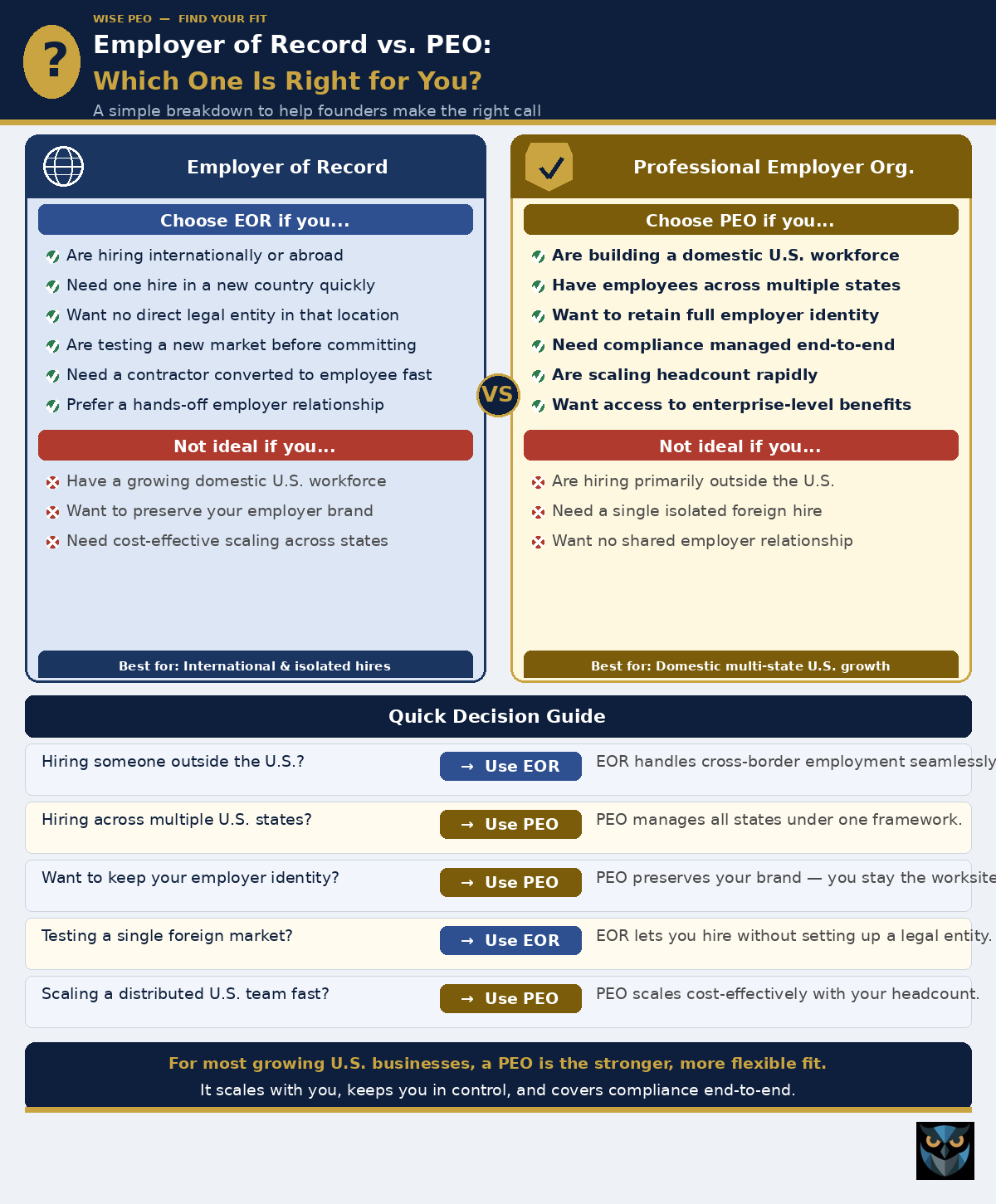
If you have a U.S.-based workforce and want to maintain employer control while offloading HR administration, a PEO is typically the stronger fit. An EOR is better suited for international hiring or contractors you want to convert to full-time employees without a local legal entity.
Step-by-Step: How to Get Started with a PEO
Transitioning to a PEO does not require months of preparation. Here is a practical roadmap:
1. Audit Your Current HR Processes: Identify where you’re spending the most time, payroll, compliance, benefits administration, or onboarding, and where the biggest risks lie.
2. Establish your current workforce and projected expansion: Specify your present employee count and your anticipated hiring for the coming year. This will dictate the range of services you’ll require.
3. Evaluate Your Multi-State Footprint: If you have remote employees in multiple states, list them out. Each state has unique payroll tax and labor law requirements.
4. Let’s get started with a PEO assessment: We’ll examine your existing operations, pinpoint any areas where you’re not meeting compliance requirements, and then craft a service package tailored to your financial constraints and the way your business works.
5. Onboard Employees to the PEO Platform: Our team handles the transition smoothly, including benefits enrollment, payroll migration, and employee communications.
6. Ongoing Compliance Monitoring: Once live, we actively monitor regulatory changes and update your policies, filings, and practices accordingly.
Advanced Insights: What Smart Founders Know About HR Outsourcing
PEOs Are Not Just for Large Companies
Many founders assume PEO services are only for companies with 50 or more employees. In practice, our clients range from 5-person seed-stage startups to 200-person Series B companies. The co-employment model is cost-effective at nearly any scale because you leverage the buying power of a much larger workforce.
Benefits Competitiveness Is a Hiring Lever
One of the most underappreciated advantages of a PEO is access to group benefits at rates that a 10-person startup could never negotiate independently. Through our HR outsourcing services, your employees can access the same health plans, 401(k) options, and supplemental benefits as employees at large corporations. In a tight labor market, this directly improves your ability to recruit and retain top talent.
PEOs Can Save You More Than They Cost
When you factor in the cost of HR software subscriptions, payroll processing fees, compliance consulting, benefits broker fees, and the time value of your team’s HR hours, most clients find that a PEO is actually more cost-efficient than managing HR in-house. Our clients typically see a 20 to 35 percent reduction in total HR-related costs in the first year.
Co-Employment Is Not the Same as Losing Control
A common misconception is that a PEO takes over your company. That’s not how it works. You hire, manage, and terminate employees as you always have. We handle the administrative and legal employer responsibilities so you don’t have to carry them alone.
When Should Your Startup Consider a PEO?
There is no single trigger that makes a PEO the right choice. It’s usually a combination of factors. Here are the most common growth signals we see:
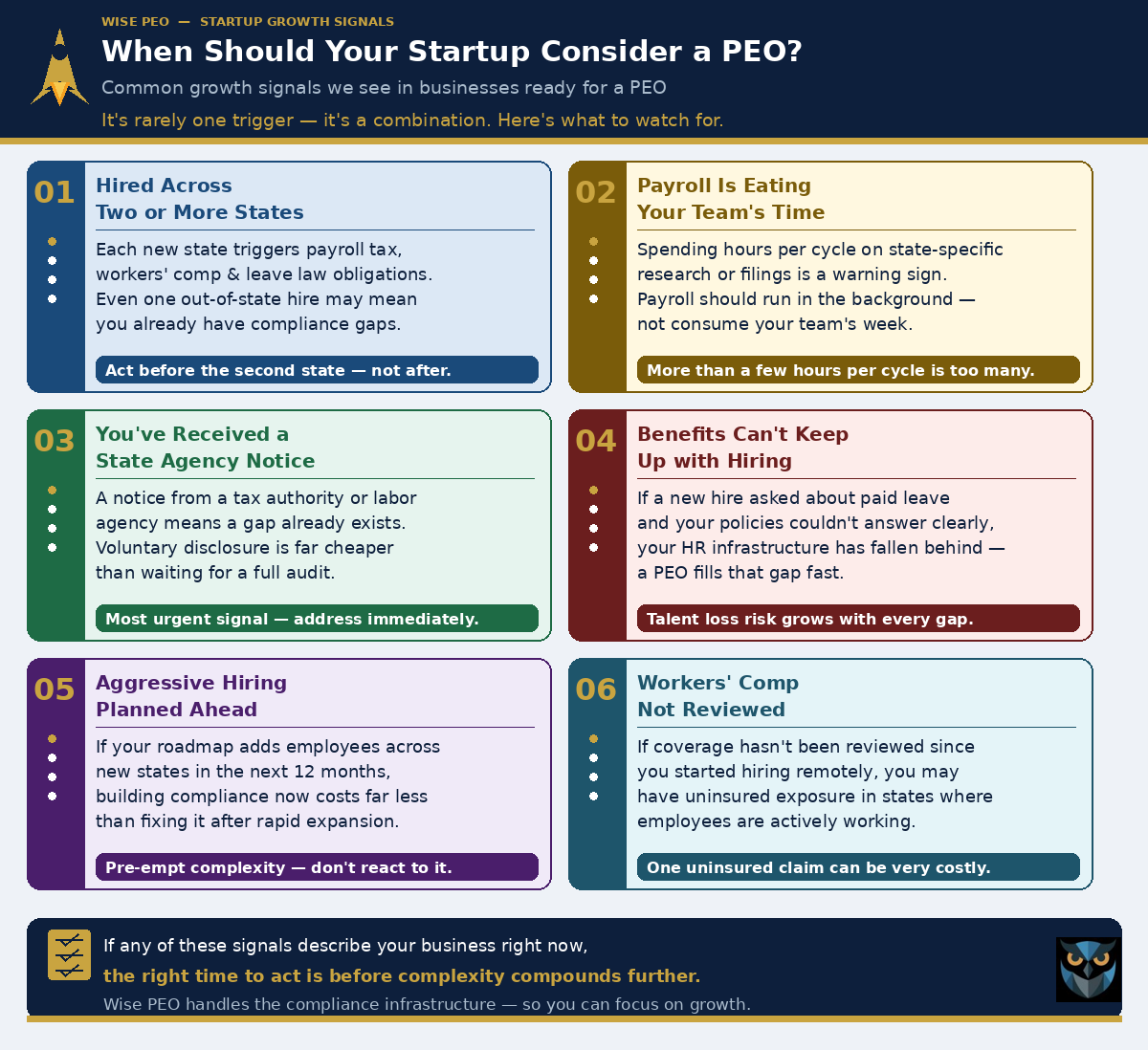
If two or more of the indicators above apply to your business, it’s worth having a conversation. Most founders who wait longer than they should tell us the same thing: they wish they had made the move sooner.
Ready to Take HR Off Your Plate?
Wise PEO partners with startups and expanding small to medium-sized businesses throughout the United States. We streamline payroll, ensure HR compliance, and provide access to attractive benefits packages, all from a single source.
Whether you’re managing a 5-person startup or a 100-person team spread across multiple states, we design a co-employment solution that fits where you are today and scales with where you’re going.
Conclusion
Scaling a business is hard enough without the burden of HR administration slowing you down. Payroll compliance, multi-state filings, benefits management, and labor law tracking are all essential, but they don’t have to fall entirely on your shoulders.
A Professional Employer Organization (PEO) partnership provides the complete HR framework a growing company needs, without the hefty price tag. We manage everything from initial payroll processing to continuous compliance, allowing you to concentrate on your core business.
The question isn’t whether you can afford a PEO. For most startups, the real question is whether you can afford not to have one.
Frequently Asked Questions
PEO benefits for startups refer to the full suite of HR, payroll, and compliance services that a Professional Employer Organization provides through a co-employment arrangement. They matter because they allow early-stage companies to access enterprise-grade HR infrastructure without the cost of building an internal department.
In 2026, U.S. businesses face updated FLSA overtime rules, expanded state pay transparency laws, new I-9 remote verification procedures, growing state-mandated retirement program requirements, and emerging AI hiring disclosure rules. Keeping up with all of these simultaneously is a significant challenge for lean teams.
An employer of record (EOR) is typically used when a company wants to hire workers in a country or state where they don’t have a legal entity. A PEO, by contrast, works with your existing U.S.-based workforce through a co-employment model, giving you shared employer responsibilities while you maintain operational control.
No, HR outsourcing is not legally required. However, federal and state compliance obligations absolutely are. Many small businesses use HR outsourcing services because it’s the most practical and cost-efficient way to meet those obligations without hiring a full-time HR team.
Generally, it’s a good idea to make the switch when your team hits five or more people. If you’re hiring across state lines, or if HR duties are eating up more than ten hours a week, that’s another signal. And, if your benefits package isn’t cutting it in terms of attracting the right people, that could be the final push.
Onboarding times fluctuate, though the majority of companies find they can get up and running on our platform in two to four weeks. We manage the complex aspects, such as moving employee data, setting up benefits, and configuring the payroll system, which means your team experiences very little disruption.
Want a deeper understanding? Check out our detailed guide on what a PEO is and discover how it can streamline HR, payroll, and compliance for your startup.
Related Posts
PEO vs. HRO: which HR outsourcing model is right for your business