
Introduction: One Payroll Mistake Can Cost You Thousands
Imagine running a 20-person company, growing steadily, and then receiving a notice from the IRS about a payroll tax deposit you missed six months ago. The penalty alone could run into the thousands. Add in interest, and the administrative cost of responding to the audit, and you are looking at a serious disruption to your business.
This scenario plays out for small and mid-size businesses across the U.S. every year, and in almost every case, it was preventable. Payroll compliance is one of the most complex, high-stakes areas of running a business, and the rules change constantly.
Whether you have 5 employees or 50, the complexity of managing payroll services accurately, staying current with federal and state tax laws, and handling multi-state obligations is far greater than most business owners expect. This guide walks you through the most common payroll compliance errors, what they cost, and how a co-employment model through a PEO eliminates the risk entirely.
What Are Payroll Compliance Services?
Payroll compliance services refer to the processes, systems, and expertise needed to ensure that every aspect of your payroll operation meets federal, state, and local legal requirements. This includes:
• Calculating and withholding the correct amounts for income tax, Social Security, and Medicare
• Depositing payroll taxes on time according to IRS schedules
• Filing quarterly and annual returns such as Form 941, 940, and W-2s
• Complying with state unemployment insurance (SUI) requirements
• Following wage and hour laws, including overtime rules under the FLSA
• Maintaining proper records for each employee and pay period
When all of these components run smoothly, payroll compliance is invisible. When something goes wrong, the consequences can be swift and costly.
Why Payroll Compliance Is More Critical Than Ever in 2026
The U.S. compliance environment has grown significantly more complex heading into 2026. Several major changes are directly affecting how businesses must manage payroll:
Updated FLSA Overtime Thresholds
The salary threshold for overtime exemption has been updated, meaning more employees now qualify for overtime pay. Businesses that have not recalculated their exempt employee classifications are already at risk of back-pay exposure.
Expanded State Pay Transparency Laws
States including California, Colorado, New York, Illinois, and Washington now require salary ranges in job postings. Non-compliance can trigger wage discrimination claims and state-level investigations.
State-Mandated Retirement Programs
Several additional states have launched or expanded mandatory retirement savings programs for private employers. Failing to enroll eligible employees can result in per-employee fines that accumulate quickly.
Remote Workforce Tax Nexus Rules
If you have employees working remotely in states where you have no physical office, you may have triggered tax nexus obligations in those states, including payroll tax registration, withholding, and SUI contributions. Many businesses are unaware of this exposure until they receive a state notice.
Struggling with payroll compliance? Learn how a PEO can simplify HR, payroll, and compliance in our complete guide: What is a PEO and How Does It Work?
How Our Payroll Compliance Services Protect Your Business
Our approach to payroll compliance is built on the co-employment model. When you partner with us, we become the employer of record for tax and benefits purposes, which means our compliance team carries the administrative and legal burden of keeping your payroll current and accurate.
Automated Tax Deposits and Filings
We handle all federal, state, and local tax deposits on your behalf, using automated scheduling tied to your payroll cycle. There are no missed deadlines, no manual calculations, and no late deposit penalties.
Multi-State Payroll Management
If your team is spread across multiple states, we manage each state’s specific withholding rates, SUI filings, minimum wage requirements, and paid leave rules separately. You get one unified payroll experience while we manage the complexity behind the scenes.
Proactive Law Change Monitoring
Our compliance team monitors federal and state regulatory updates continuously. When a new law takes effect, your payroll and HR policies are updated automatically. You do not need to subscribe to HR newsletters or hire a compliance consultant to stay current.
Year-End Processing and W-2 Management
We manage all year-end reconciliation, W-2 generation, and ACA reporting. Employees receive accurate forms on time, and you avoid the frantic year-end scramble that many small businesses experience.
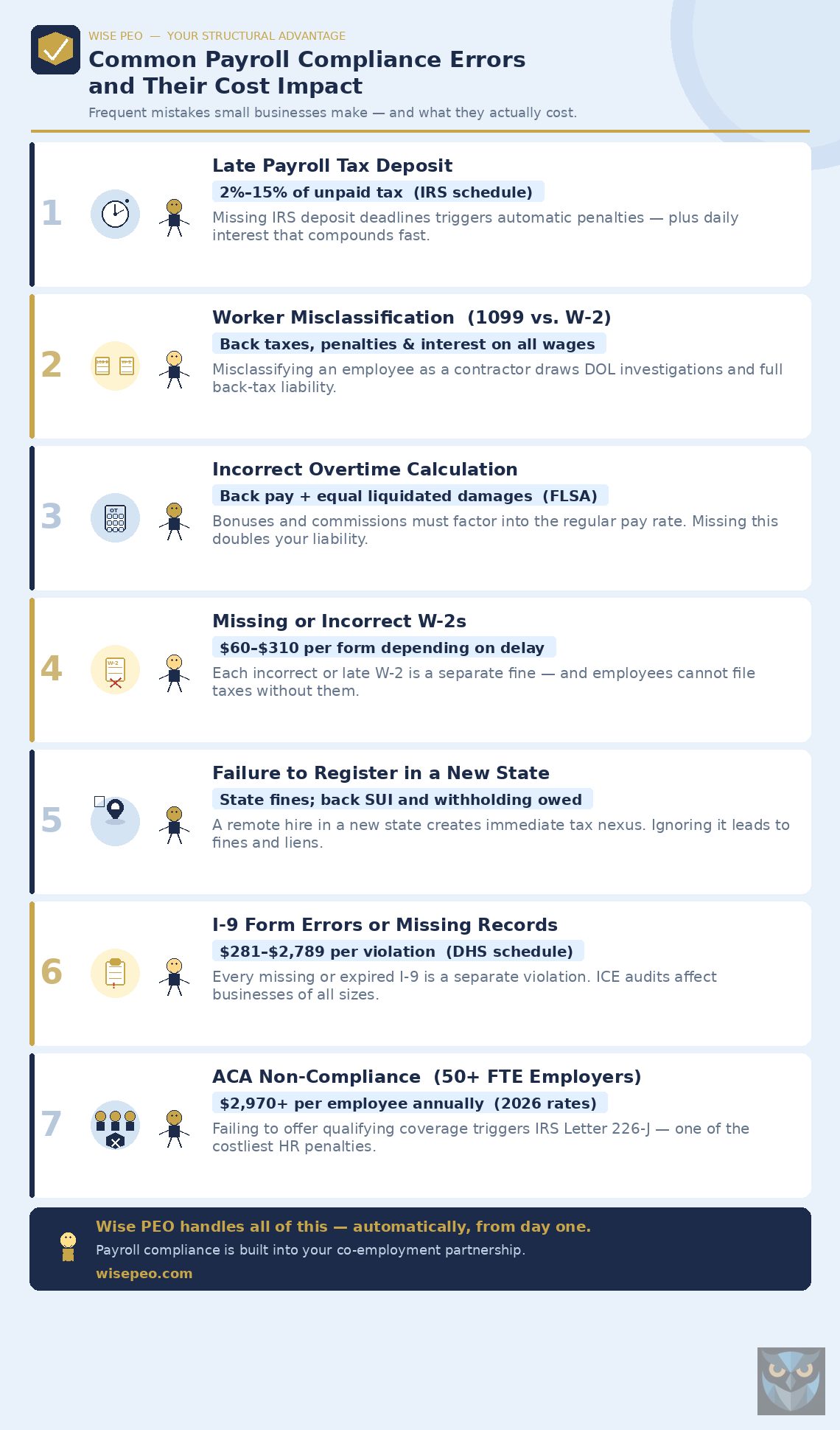
Common Payroll Compliance Errors and Their Cost Impact
The table below outlines the most frequent compliance errors we see among small and growing businesses, along with the real penalties they carry:
Step-by-Step: How to Audit Your Current Payroll Compliance
Even if you are not ready to partner with a PEO today, running a quick internal audit can help you identify where your risk exposure is highest. Here is a practical starting framework:
1. Review your worker classifications. Go through your full roster and verify whether each worker is correctly classified as an employee or independent contractor. The IRS uses a multi-factor test, and misclassification is one of the most common triggers for audits.
2. Check your tax deposit schedule. Confirm whether you are on a monthly or semi-weekly deposit schedule for federal payroll taxes, and verify that all deposits are being made on time.
3. Audit your overtime calculations. Review how overtime is calculated for any non-exempt employees, particularly if they receive bonuses or commissions. These must be factored into the regular rate of pay under FLSA rules.
4. Verify your multi-state obligations. If any of your employees work remotely in other states, confirm whether you have registered for payroll taxes, SUI, and workers’ compensation in those states.
5. Review your I-9 records. Every employee hired after November 1986 must have a completed I-9 on file. Errors, missing sections, or expired documents can result in per-form fines during an audit.
6. Confirm your new hire reporting. Most states require employers to report new hires to a state agency within a set number of days. Check your state’s deadline and verify your process is meeting it.
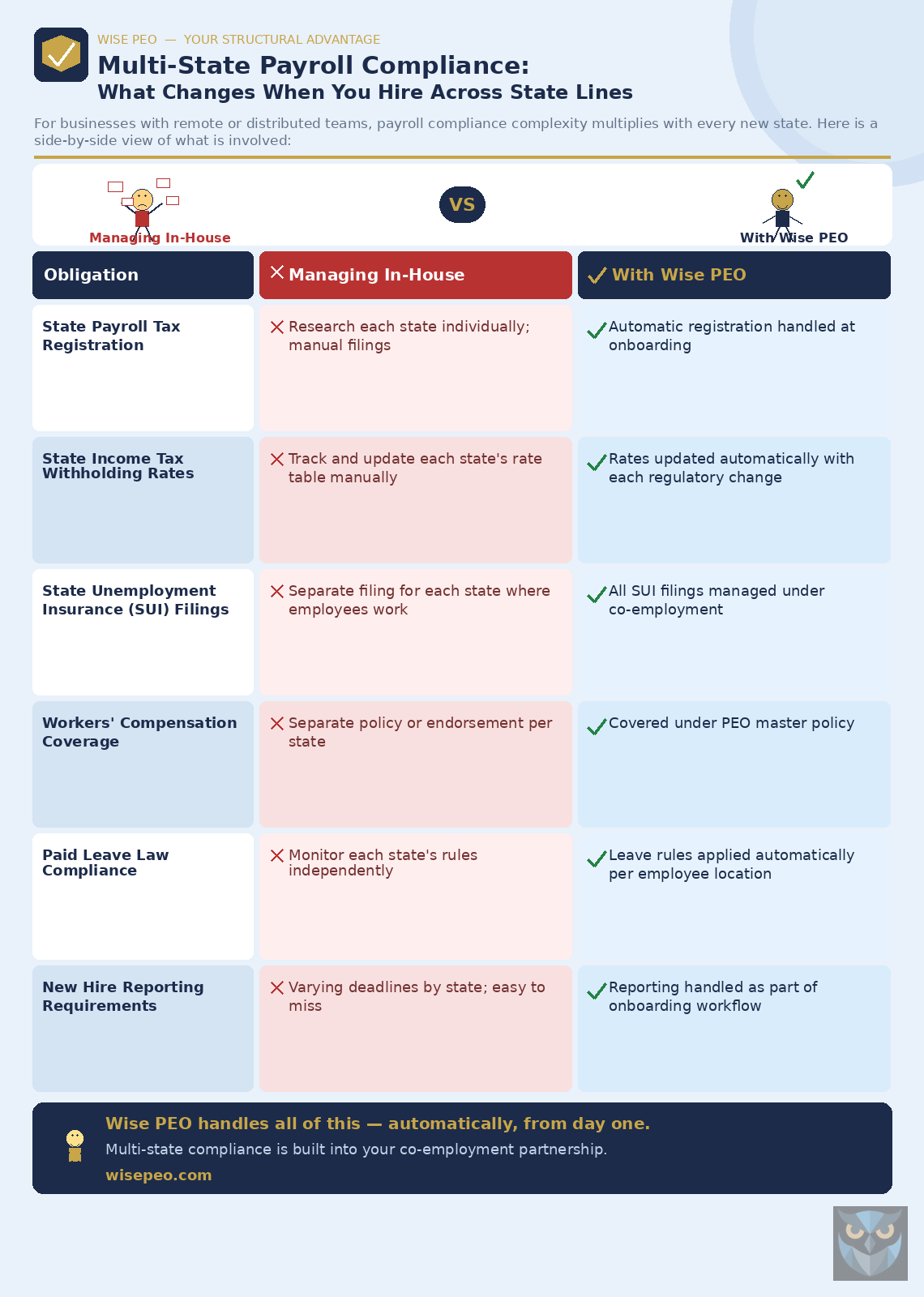
Multi-State Payroll Compliance: What Changes When You Hire Across State Lines
For businesses with remote or distributed teams, payroll compliance complexity multiplies with every new state. Here is a side-by-side view of what is involved:
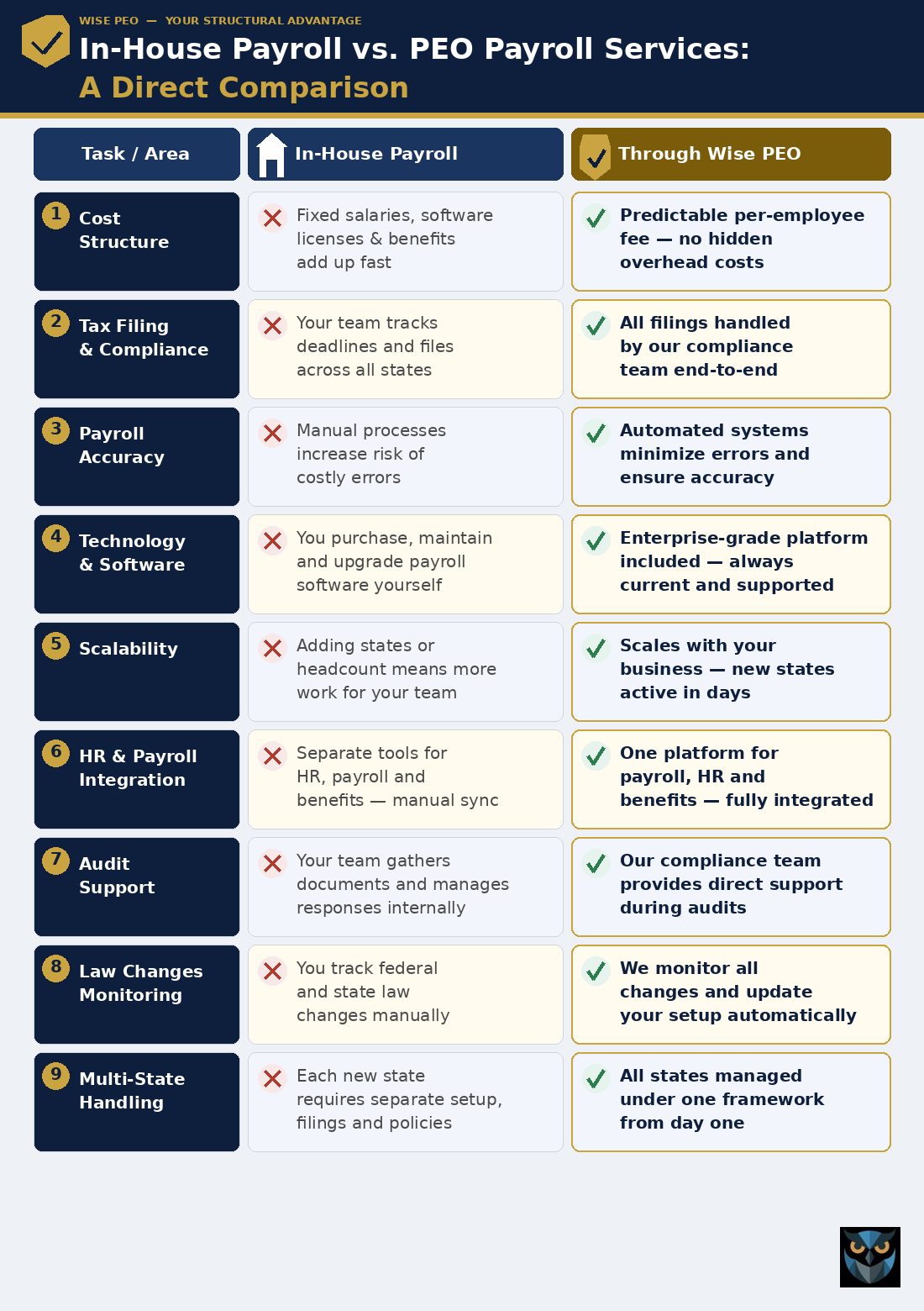
In-House Payroll vs. PEO Payroll Services: A Direct Comparison
The Most Costly Mistakes Businesses Make With Payroll Compliance
Treating Payroll as Just a Finance Function
Many small businesses assign payroll to a bookkeeper or office manager who handles it alongside other responsibilities. Payroll compliance requires dedicated knowledge of tax law, employment regulations, and state-specific rules that go well beyond accounting.
Relying on Outdated Payroll Software
Basic payroll software tools often lag behind regulatory changes. If your system has not been updated to reflect 2026 overtime thresholds, revised SUI rates, or new state pay stub requirements, you are already out of compliance without knowing it.
Ignoring the Cost of DIY Compliance
Business owners often resist outsourcing payroll because of the perceived cost. In reality, the time spent managing payroll manually, the cost of errors and penalties, and the risk of an IRS audit nearly always exceed the cost of professional payroll compliance services.
Waiting Until Something Goes Wrong
Most compliance failures we see could have been avoided with routine monitoring. By the time a business receives a state notice or IRS penalty, the issue has often been building for months. Proactive compliance management is far less expensive than reactive damage control.
Expert Insights: What Experienced HR Consultants Know About Payroll Compliance
The Employer of Record Model Shifts Your Risk Profile
Under a standard employer setup, all payroll compliance liability rests entirely with the business. Under the employer of record vs. PEO co-employment model, compliance responsibilities are shared. Our team carries the administrative burden, and our systems are built to stay current with every regulatory change.
Small Businesses Are Audited Too
There is a common misconception that the IRS and state agencies focus only on large employers. In practice, small businesses are frequently targeted precisely because they are more likely to have compliance gaps. Payroll tax non-compliance is one of the top areas the IRS pursues regardless of company size.
Compliance Is a Competitive Advantage
Businesses that manage HR compliance for small businesses professionally are better positioned to scale quickly. They face fewer disruptions, attract stronger talent, and avoid the legal exposure that slows down growth or derails financing rounds. Clean compliance records matter when you are pursuing investment or a business acquisition.
When Should You Consider Outsourcing Payroll Compliance?
There is no single moment that makes outsourcing the right move for every business. But the following signs consistently appear among the clients who benefit most from our payroll compliance services:
• You have received a payroll tax notice or penalty in the past 12 months
• You are expanding into new states and are unsure of your obligations
• Your payroll is processed manually or with basic consumer-grade software
• HR or payroll tasks are consuming more than 8 hours per week of management time
• You have recently crossed 10 employees and your process has not scaled with you
• Your workforce includes a mix of employees and contractors and classifications have not been reviewed recently
• You are planning a hiring push and want to build a compliant foundation before scaling
Take Payroll Compliance Off Your Plate
Managing payroll compliance in-house is a high-stakes task that gets more complex every year. Between federal rule changes, state-specific requirements, and the growing complexity of remote workforces, the margin for error is getting smaller.
Our payroll compliance services are designed to give growing businesses the same level of protection and infrastructure that large corporations have, without the overhead of a full HR department. From day-one tax filings to year-end W-2 management, we handle it all under one co-employment partnership.
Schedule consultation and talk to a payroll compliance expert today.
Conclusion
Payroll compliance is not a set-it-and-forget-it function. It requires ongoing attention, current knowledge of federal and state regulations, and systems built to scale with your business. For most small and mid-size businesses, managing this in-house is a significant drain on time and resources.
The companies that get ahead are not necessarily the ones with the largest HR teams. They are the ones that build the right infrastructure early. A PEO partnership gives you that infrastructure, along with the peace of mind that comes from knowing your payroll is accurate, compliant, and protected.
Avoid costly payroll errors, discover how partnering with a PEO can streamline compliance and reduce risk. Read our in-depth guide to see how it works.
Frequently Asked Questions
Payroll compliance services cover all the processes required to ensure your payroll meets federal, state, and local legal standards. They matter because non-compliance can trigger IRS penalties, state fines, back-pay liabilities, and audits that are costly and time-consuming to resolve.
Key 2026 changes include updated FLSA overtime salary thresholds, expanded pay transparency laws in multiple states, new state-mandated retirement program requirements, and evolving tax nexus rules for remote workers. Businesses that have not reviewed their payroll practices against these updates may already have exposure.
Under the co-employment model, a PEO becomes the employer of record for tax and benefits purposes and takes on shared responsibility for payroll compliance. Unlike in-house management, a PEO provides dedicated compliance expertise, automated tax filings, and proactive monitoring of regulatory changes.
Yes. Federal payroll tax obligations apply from the moment you hire your first employee. State requirements vary but are generally just as stringent. Small businesses are not exempt from IRS or state audits, and the penalties are applied regardless of company size.
The right time is typically when payroll is consuming significant management time, when you are hiring in multiple states, or when you have had a compliance gap or penalty. Many businesses benefit from outsourcing as early as their first hire, since getting the foundation right from day one is far easier than fixing problems later.
An employer of record (EOR) is typically used for international or contract-based hiring, where the EOR entity employs workers on behalf of the business. A PEO works alongside U.S.-based businesses through a co-employment agreement, sharing payroll and HR compliance responsibilities while the business retains full operational control over its team.