
It starts with one hire. A strong candidate, based in a different state from your headquarters. You bring them on, add them to payroll, and move on. What most business owners do not realise until much later is that a single out-of-state employee can activate a cascade of compliance obligations: state income tax registration, unemployment insurance in a new jurisdiction, workers’ compensation in that state, and possibly paid leave requirements that differ entirely from where you are headquartered.
Now picture that scenario playing out across four or five states. Each with its own wage rates, leave laws, pay stub requirements, and quarterly filings. You are not running an HR department at that point. You are running a compliance operation, and it is consuming time your business cannot afford to lose.
This is the reality for hundreds of growing U.S. businesses, and it is precisely the kind of complexity that professional employer organization PEO services are built to absorb. The co-employment model does not just process payroll. It manages your multi-state footprint as a built-in function, so you can hire wherever the right talent lives without turning it into an administrative project.
You Might Already Have Multi-State Obligations and Not Know It
The biggest misconception we hear from business owners is that multi-state compliance only applies to large companies with offices across the country. In practice, it applies the moment you have a single employee working from a state other than your own, regardless of your company size.
What qualifies as triggering a state obligation is broader than most people expect. It is not just about where your company is registered or where you have a lease. States look at where your employees are physically working, and that has become a much more significant issue since remote work became mainstream.
Many of the businesses that come to us after receiving a state agency notice have been unknowingly out of compliance for months. The obligation existed from day one of that remote hire. They simply had no system to catch it.
Managing payroll across states is just one piece of the puzzle. Learn the full scope of what a PEO can do for your business in our complete guide: What is a PEO and How Does It Work?
No Two States Play by the Same Rules
Even experienced HR professionals can underestimate how dramatically employment law varies across state lines. Minimum wage rates, paid family leave programs, pay stub requirements, termination notice rules, and retirement savings mandates are all set at the state level, and they change frequently.
To give you a concrete sense of the variation, here is a snapshot of key employer obligations across six commonly affected states as of 2026. Note that wage rates and specific thresholds can change at the start of each year, which is why real-time monitoring matters.
How We Handle Multi-State Complexity So You Do Not Have To
The structural advantage of a PEO is that multi-state compliance is not an add-on or a premium service. It is part of how the co-employment model works. Our payroll and HR infrastructure is already operating in every state, which means when you hire in a new one, you are stepping into a framework that is already compliant, not building one from scratch.
State Tax Registration and Filings
Every state where you have employees requires payroll tax registration, quarterly or annual filings, and in many cases separate SUI accounts. We manage all of that on your behalf. When you add a new employee in a new state, the registration process is handled by our compliance team, not yours.
Workers’ Compensation Coverage Across State Lines
Workers’ compensation requirements vary significantly by state, and some states require separate coverage. Under our co-employment arrangement, your employees are covered under our master workers’ compensation policy, which spans all active states. You do not need to source and manage separate policies as you expand.
Paid Leave Management by Employee Location
Rather than building a one-size-fits-all leave policy that either over-promises or creates compliance gaps, our platform tracks leave entitlements by employee location. A team member in Colorado accrues under the FAMLI program. An employee in New York falls under NYPFL. Each person gets what the law in their state requires, and your records stay accurate.
Minimum Wage Adjustments on Effective Dates
State minimum wages often change on January 1st or July 1st. For a business managing payroll in-house across multiple states, catching every effective date and updating pay rates accordingly is a real operational risk. Our systems apply these adjustments automatically, so no employee’s pay is ever inadvertently out of compliance.
Managing Multi-State Payroll Yourself vs. Through a PEO
This comparison shows what the same set of tasks looks like depending on whether your business is handling them in-house or through a PEO co-employment model:
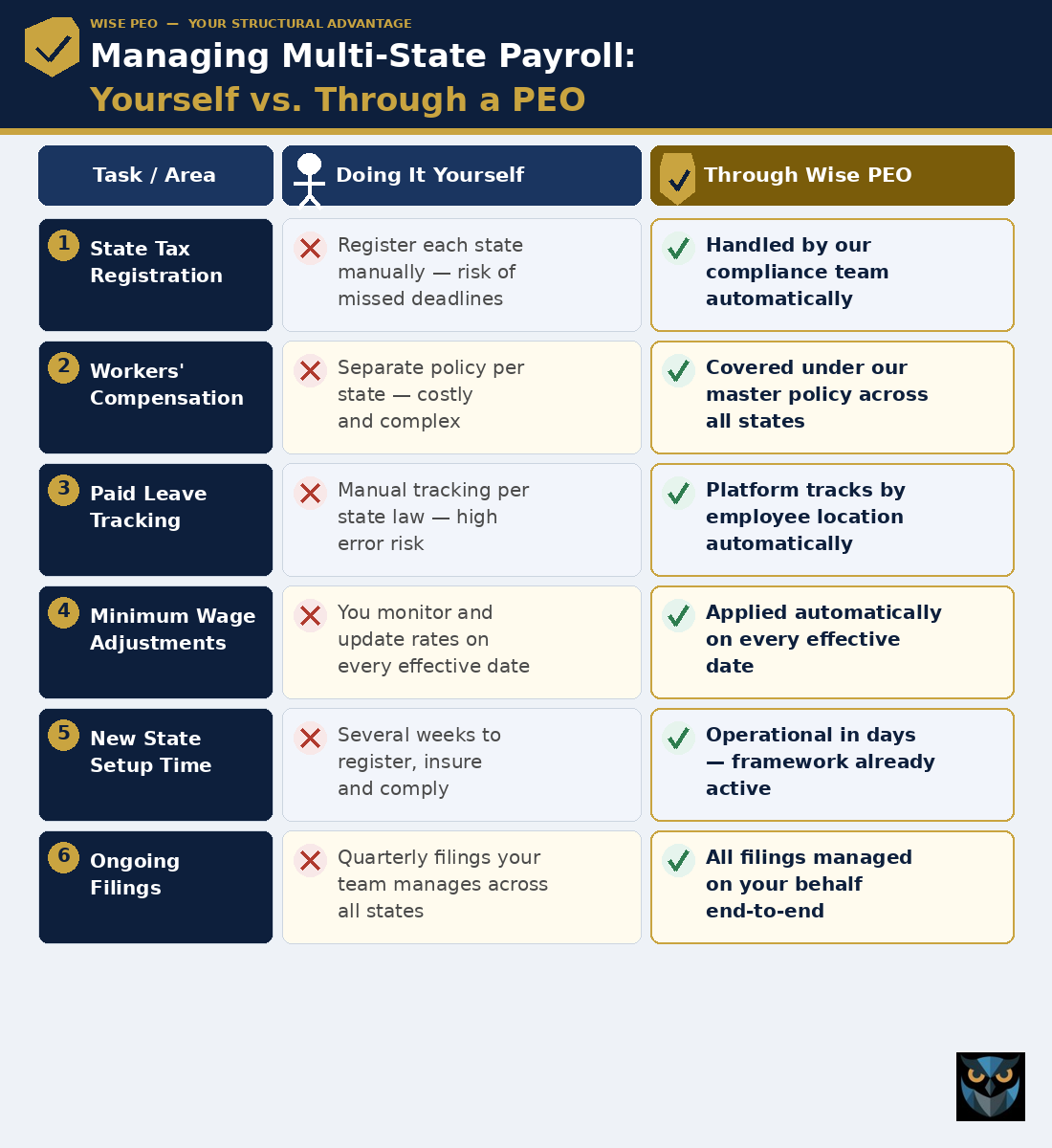
The last row is the one most business owners find most impactful. Setting up payroll compliance in a new state manually can take several weeks, particularly if you need to register for SUI, obtain workers’ compensation coverage, and update your employee handbook with state-specific addenda. Through our platform, a new state can be operationalised in days.
Three Things Business Owners Get Wrong About Multi-State Payroll
Myth 1: My payroll software handles all of this automatically
Payroll software is a calculation and filing tool. It processes what you set up. If you have not registered for payroll tax in a state, your software will not do it for you. If your SUI rate in a new state is wrong, it will calculate based on whatever rate you entered. The software has no compliance intelligence. It is only as accurate as the setup behind it.
Myth 2: Our employment attorney can keep us covered
Employment attorneys are invaluable for specific legal questions and disputes. They are not built to manage the day-to-day operational complexity of multi-state payroll. Retaining counsel for every quarterly filing, every rate change, and every new hire in a new state is not practical, and most attorneys would tell you the same thing.
Myth 3: We will deal with this when we are bigger
The compliance obligation exists from the first day an employee works in a new state. Waiting until you have ten employees in that state does not reduce the liability you accumulated in the meantime. It just means you are managing a larger remediation effort when the issue eventually surfaces, and these issues do surface, usually in the form of a state agency notice or an audit.
A Note on Employer of Record vs. PEO for Multi-State Hiring
When business owners start researching options for managing out-of-state employees, they often encounter both employer of record (EOR) and PEO as potential solutions. They are related concepts but serve different use cases.
An EOR becomes the legal employer of a worker in a specific location, which is most useful for international hiring or situations where a company wants no direct employment relationship in a particular jurisdiction. A PEO, by contrast, enters a co-employment relationship with your existing business. You remain the worksite employer. We handle the administrative and compliance infrastructure alongside you.
For domestic U.S. businesses building a multi-state workforce, a PEO is almost always the more appropriate and more flexible model. It scales with your business, preserves your employer identity, and gives you the compliance infrastructure without requiring you to give up operational control.
How to Know When Your Multi-State Setup Has Become a Liability
There is rarely a single defining moment. It tends to be a gradual accumulation of complexity until something breaks. These are the signs we see most consistently in businesses that come to us for help:
• You have hired in two or more states in the past year and are not entirely certain you completed every required registration
• Your payroll team is spending more than a few hours per pay period on state-specific research or reconciliation
• You have recently received a notice or inquiry from a state tax authority or labor agency
• A new employee in another state asked about paid leave or benefits and you realised your current policies do not clearly address their situation
• You are planning to hire aggressively in the next 12 months and expect to add employees in new states
• Your workers’ compensation coverage has not been reviewed since you started hiring remotely
If any of these describe your current situation, the right time to address it is now, before the complexity compounds further and before a compliance gap becomes a financial one.
Hiring Across State Lines Should Be a Business Decision, Not a Compliance Obstacle
The best talent is not always in your state. If your HR infrastructure limits where you can hire without creating significant operational risk, that is a constraint on your business growth that does not need to exist.
Wise PEO payroll compliance services are built to make geographic expansion operationally simple. Whether you are adding your first out-of-state employee or managing a distributed team across a dozen states, our co-employment model handles the compliance complexity end to end.
Struggling with compliance across multiple states? A PEO can streamline far more than payroll. Explore how it works in our pillar guide: What is a PEO and How Does It Work?
FAQ
The obligation begins the moment you have an employee performing work in a state other than where your business is registered, regardless of whether that state has a physical office. Remote work has made this one of the most common compliance blind spots for small and mid-size businesses.
Yes, and some businesses do. The challenge is that state registration is just the starting point. You then need to manage ongoing filings, track rate changes, maintain correct paid leave policies for each location, and update your practices every time a state changes its rules. For businesses managing multiple states simultaneously, that operational burden grows quickly.
For a business with W-2 employees spread across multiple U.S. states, a PEO is typically the stronger fit. An EOR takes on the full legal employer role in a specific jurisdiction, which is better suited to international hiring or isolated contractor situations. A PEO operates alongside you as a co-employer, giving you more control and flexibility while managing the compliance infrastructure.
The practical next step is a compliance audit to understand the full scope of the exposure, followed by a remediation plan. Many states have voluntary disclosure programs that reduce penalties for businesses that proactively come into compliance. The earlier you address it, the more manageable the resolution tends to be. This is also one area where our team can provide direct support during an onboarding transition.
For most businesses, onboarding to a new state through our platform takes days rather than the weeks it would typically require if done independently. Our compliance infrastructure is already active in every U.S. state, which means we are configuring your specific setup rather than building from scratch.
Independent contractors are not subject to payroll tax withholding in the same way employees are, but their presence in certain states can still create a business tax nexus. Beyond that, if a contractor’s working relationship meets the criteria for employment under that state’s classification rules, you may face payroll and benefit obligations retroactively. States like California apply a particularly strict test, and the consequences of misclassification there are significant.