
Here is a scenario that plays out more often than it should. A business with 15 employees is running smoothly. Revenue is up, the team is growing, and the owner is focused on what matters: customers and growth. Then a state labor agency sends a letter about a missed wage statement requirement. Or a former employee files a complaint about overtime miscalculation. Or the IRS opens an inquiry into payroll tax deposits.
None of these things happened because the business was careless. They happened because HR compliance for small business has quietly become one of the most demanding operational challenges in the U.S., and most small business owners are managing it with tools and knowledge that have not kept pace with how quickly the rules are changing.
This is where professional employer organization PEO services change the equation entirely. Rather than trying to keep up with an increasingly complex compliance landscape on your own, a PEO handles it as part of a co-employment partnership that is built specifically for growing businesses.
HR Compliance in 2026: A Landscape That Has Shifted Under Your Feet
The volume of HR regulation affecting U.S. small businesses has grown considerably over the past few years, and 2026 has continued that trend. What used to be manageable with a basic employee handbook and a payroll software subscription now requires specialized knowledge across multiple legal domains.
Federal agencies, state legislatures, and even local governments are each adding their own layer of requirements. When you hire a remote employee in a new state, for example, you may be triggering obligations you were never aware of, including payroll tax registration, state unemployment insurance, paid leave laws, and workers’ compensation coverage in that state.
For a business owner wearing five hats, staying current with all of this is not realistic. It is also not your job. The businesses that scale most effectively are the ones that recognize which operational risks need professional management and act on that early.
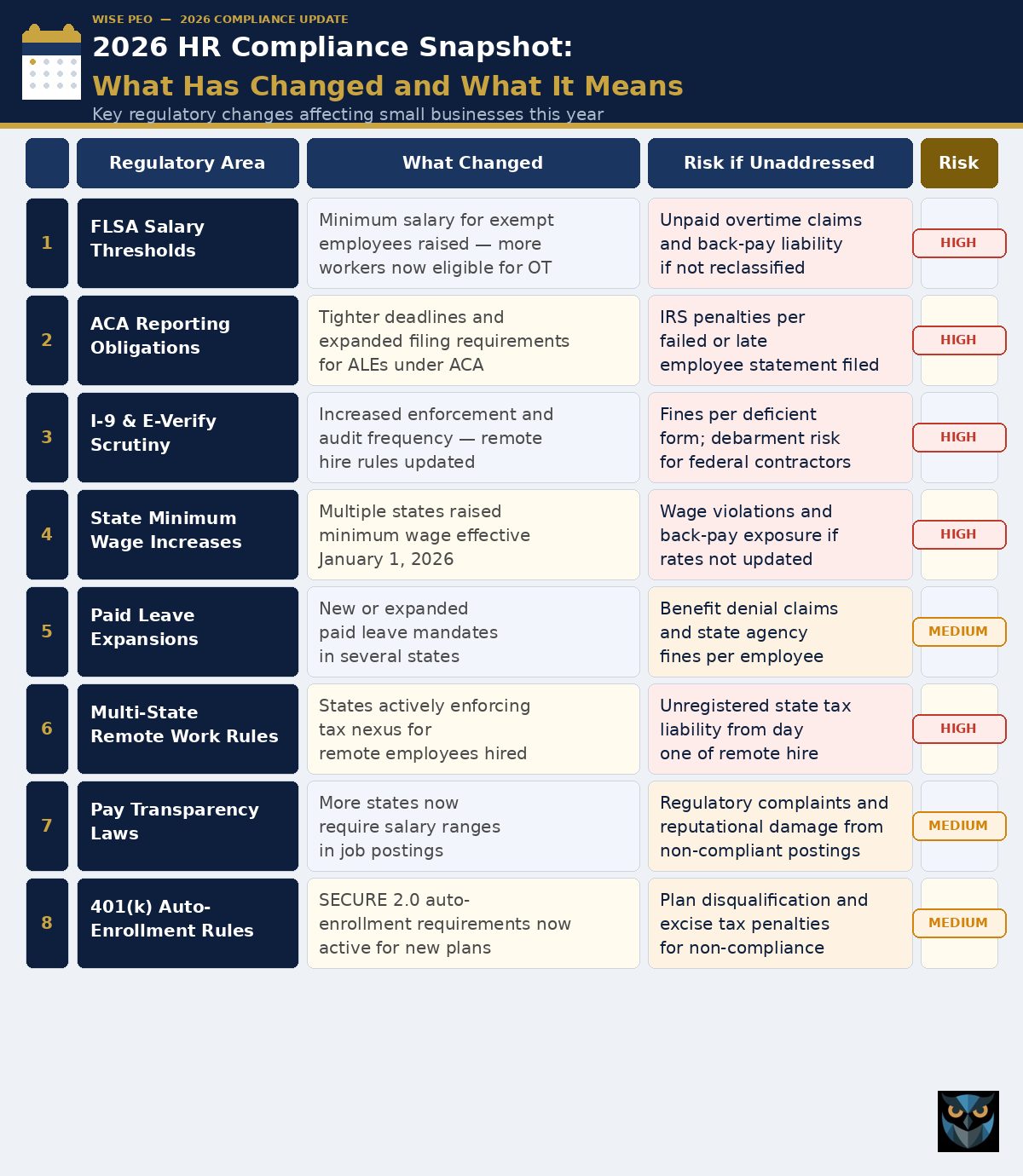
2026 HR Compliance Snapshot: What Has Changed and What It Means
The table below summarizes the key regulatory changes affecting small businesses this year, along with the risk exposure each one carries if left unaddressed:
The Seven HR Compliance Challenges Hitting Small Businesses Hardest Right Now
1. Keeping Pace With Wage and Hour Law Updates
The updated FLSA overtime salary threshold means a meaningful number of employees who were previously classified as exempt may no longer qualify for that status. If your compensation structure has not been reviewed against the new thresholds, you may be sitting on back-pay liability without knowing it.
Beyond overtime, minimum wage rates continue to rise in states and municipalities at different paces. Businesses with employees in multiple locations need a system that tracks the applicable minimum for each worker, not just the federal floor.
2. Managing Remote Worker Compliance Across State Lines
Remote work has permanently changed the employer-employee relationship from a compliance standpoint. When your employee works from their home in a state where you have no office, that state may view you as an employer operating within its borders and subject to its laws.
This affects payroll tax registration, SUI contributions, workers’ compensation, and in some cases local income tax withholding. Most small businesses discover this exposure reactively, after receiving a state notice rather than through proactive planning.
3. Pay Transparency Requirements
Pay transparency laws are no longer limited to a handful of progressive states. They are spreading, and the requirements vary significantly by jurisdiction. Some states require salary ranges in job postings. Others mandate that ranges be provided to candidates upon request or before an offer is extended.
Non-compliance can expose your business to wage discrimination claims, state agency investigations, and reputational damage with candidates and current employees who learn about inconsistent pay practices.
4. Benefits Compliance Under the ACA
Affordable Care Act compliance remains a live issue for businesses approaching 50 full-time equivalent employees. Even businesses below the employer mandate threshold need to ensure their benefits offerings are structured correctly and that any required reporting is filed on time.
The challenge for small businesses is that group health plan administration, ACA reporting, and COBRA management are genuinely complex. Many small employers are over-relying on their insurance broker when what they actually need is an HR compliance partner with systems built for this.
5. Worker Classification in a Mixed Workforce
Many growing businesses use a combination of W-2 employees and independent contractors. The IRS and the Department of Labor use different tests to evaluate classification, and several states have adopted their own stricter standards, including California’s ABC test.
The financial consequences of misclassification are significant. Depending on the situation, a business can face back taxes, unpaid benefits, employment tax penalties, and civil litigation from misclassified workers.
6. Documentation and Policy Gaps
A compliant employee handbook is not a one-time exercise. It needs to reflect current law, including updates to leave policies, harassment and discrimination requirements, and any state-specific provisions. Businesses that set up their handbook three or four years ago and have not touched it since are almost certainly operating with outdated policies.
In a dispute, your employee handbook is often the first document a labor attorney or state agency will examine. Gaps and outdated language can be used against you even when your intent was always to do the right thing.
7. State-Mandated Retirement Plan Enrollment
The trend of states mandating private employers to provide retirement plans, or to enroll employees in state-run programs, is on the rise. Each of these programs comes with its own set of rules: enrollment deadlines, contribution requirements, and how employees must be notified.
For companies operating in several states, keeping track of all this manually can be a real headache. Failing to meet enrollment deadlines means facing quarterly fines for each employee, and those add up fast.
Facing HR compliance challenges? Learn how a PEO can help manage compliance, payroll, and HR in our complete guide: What is a PEO and How Does It Work?
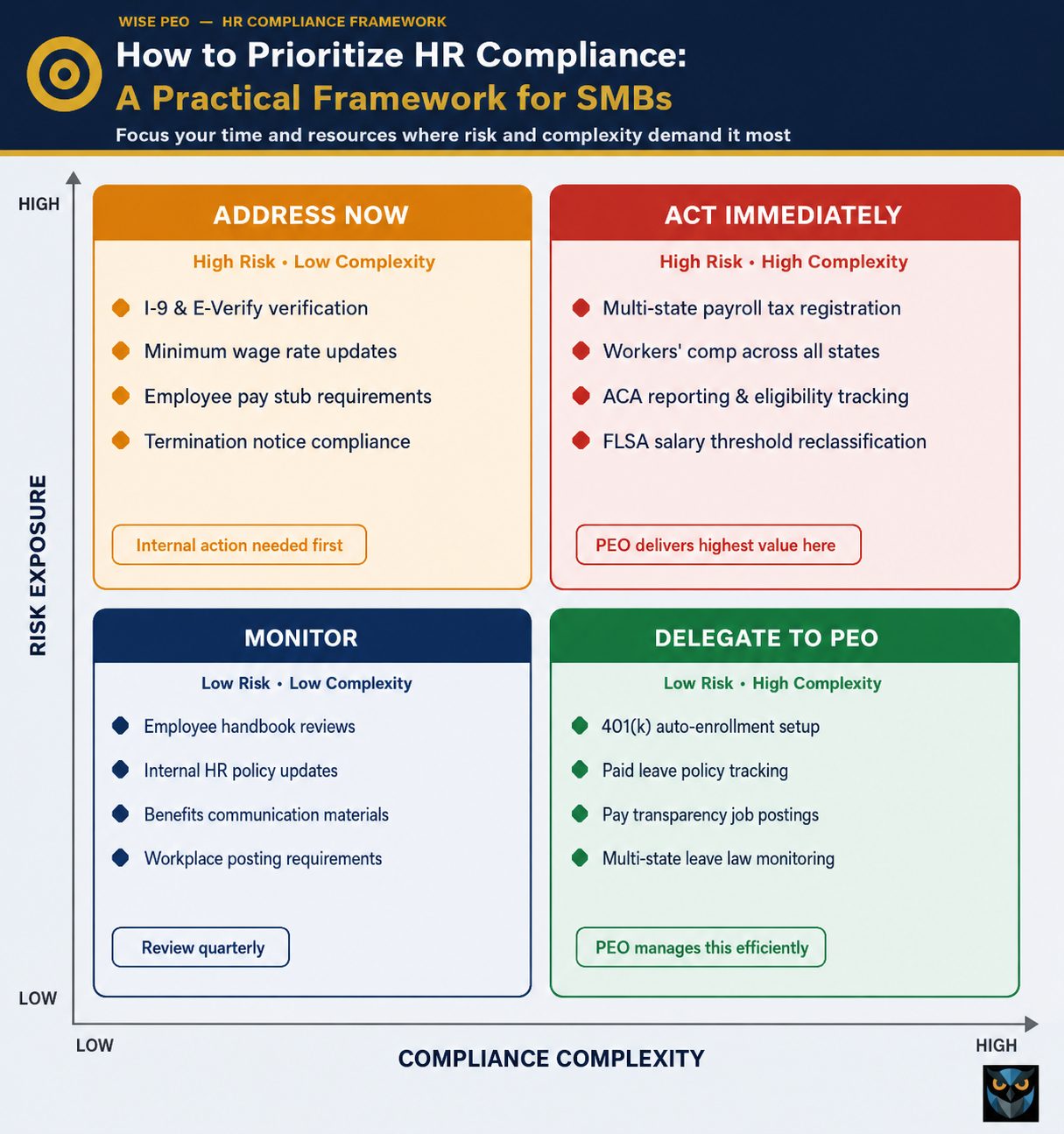
How to Prioritize HR Compliance: A Practical Framework for SMBs
Not every compliance requirement carries the same level of risk. Understanding where to focus first helps business owners allocate their time and resources more effectively. The matrix below gives you a clear view of what requires urgent attention and where a PEO delivers the most immediate value:
How a PEO Partnership Addresses These Challenges Directly
The co-employment model is specifically designed to solve the compliance challenges outlined above. When you partner with a professional employer organization, your business gains access to a compliance infrastructure that would be cost-prohibitive to build internally.
Shared Employer Responsibilities
Under a PEO arrangement, we become the employer of record for tax and benefits purposes. This means our compliance team, not yours, is responsible for staying current with federal and state employment law, filing payroll taxes accurately and on time, and managing benefits administration in line with ACA requirements.
Multi-State Expertise Built In
Every state in which your employees work is a state where our systems are already operating. We manage the payroll tax registrations, SUI filings, workers’ compensation, and paid leave obligations for each location. You do not need to hire a multi-state HR specialist or retain an employment attorney in every state you hire in.
Proactive Policy Management
Our HR outsourcing services include regular updates to your employee handbook and HR policies as laws change. You are not waiting to find out something has changed after a complaint is filed. Your policies are updated proactively, and your team is notified of changes that affect how you manage your workforce.
Employer of Record vs. PEO: Choosing the Right Model for HR Compliance
A question that comes up often among growing businesses is whether an employer of record or a PEO is the better fit for managing HR compliance. The answer depends on the nature of your workforce and your growth trajectory:
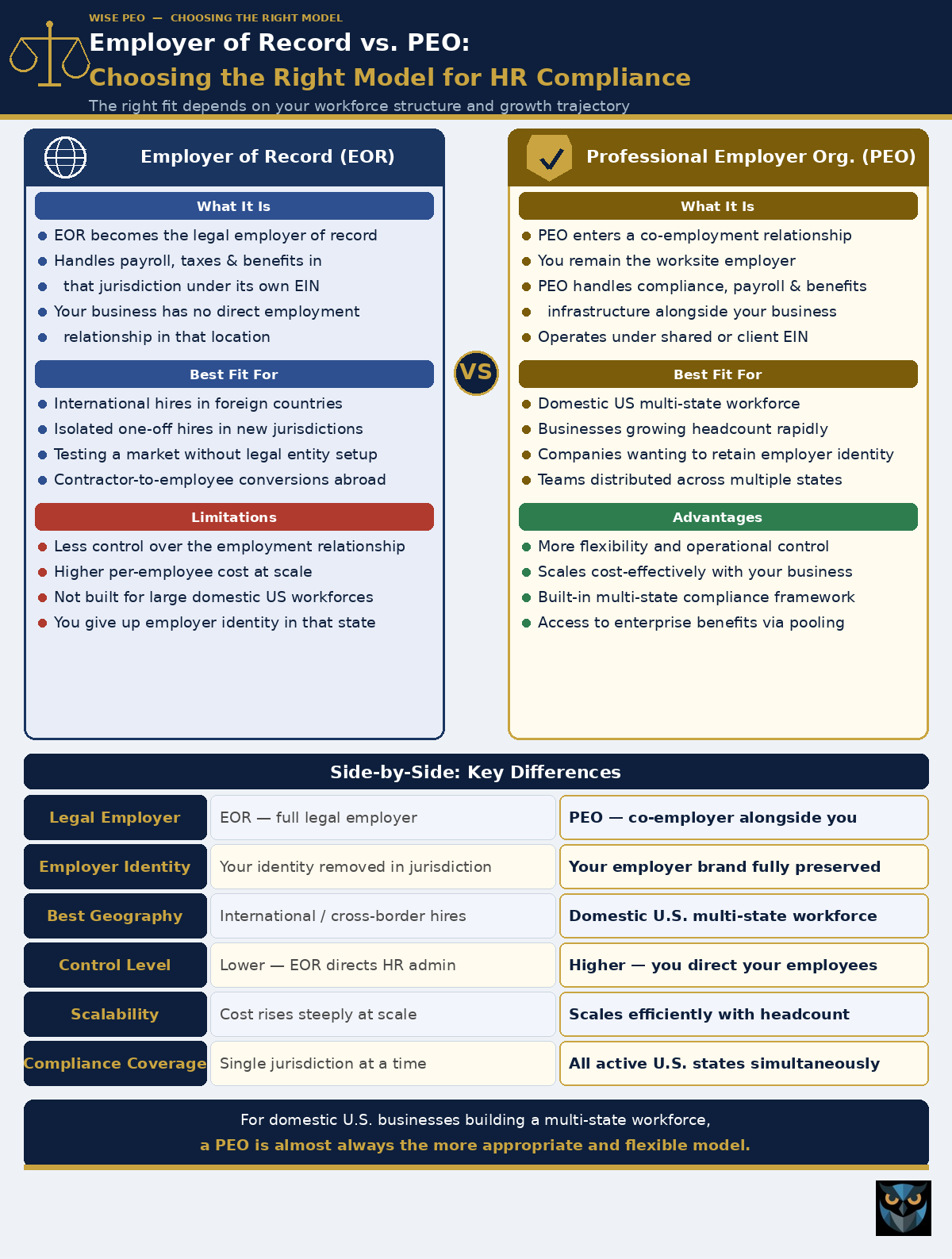
For most U.S.-based businesses with a core team of W-2 employees, a PEO partnership delivers broader compliance coverage, more flexibility, and a stronger foundation for long-term growth than an EOR arrangement.
A Practical Starting Point: Six Steps to Assess Your Current Compliance Exposure
If you are not sure where your business stands today, this framework gives you a structured way to find out:
1. Map your workforce by state: List every state where you have employees working, whether in an office or remotely. For each state, confirm whether you are registered for payroll tax, SUI, and workers’ compensation.
2. Review your FLSA classifications: Check every employee classified as exempt against the current salary threshold. Verify that their job duties also meet the FLSA duties test, not just the salary test.
3. Pull your employee handbook and check the date: If it has not been formally reviewed in the past 18 months, treat it as out of date. Key areas to audit include leave policies, harassment and discrimination language, and any state-specific addenda.
4. Check your retirement plan status: If you operate in a state with a mandatory retirement savings program, confirm that you are enrolled and meeting the employer notification requirements.
5. Audit your independent contractor relationships: For every contractor you work with regularly, evaluate whether that relationship would hold up under IRS or state classification scrutiny. Pay particular attention to anyone who works exclusively for your business.
6. Evaluate your pay transparency posture: If you are hiring in California, Colorado, New York, Illinois, Washington, or any other state with active pay transparency requirements, confirm that your job postings and internal pay practices are compliant.
Signals That Your Business Has Outgrown Its Current HR Setup
There is rarely a single moment when it becomes obvious that your HR infrastructure needs an upgrade. It is usually a pattern of smaller signals that builds over time:
• HR and compliance questions are landing on the owner’s desk regularly because there is no one else to answer them
• You have hired in a new state and are not fully certain what obligations that triggered
• A recent hire asked about benefits and the answer was not competitive enough to close the offer
• You have not reviewed your employee handbook since it was first drafted
• Year-end payroll reconciliation takes significantly longer than it should
• You are planning to double or triple headcount in the next 12 months and the current process will not scale
If two or more of these apply to your business, the cost of not addressing your compliance infrastructure is almost certainly growing faster than the cost of fixing it.
The Right Infrastructure Makes Compliance a Non-Issue
HR compliance for small businesses does not have to be a source of ongoing anxiety. With the right partner and the right systems in place, it becomes a background function that runs reliably, protects your business, and supports your growth rather than slowing it down.
Wise PEO services are built for exactly this, businesses that are growing fast and cannot afford to have compliance gaps slow them down or expose them to legal risk. We handle the complexity so you can stay focused on building.
Stay ahead of HR compliance in 2026, discover how a PEO can reduce risk and simplify operations. Read our in-depth guide to see how it works.
FAQ
Larger businesses have dedicated HR and legal teams whose entire job is to track regulatory changes and maintain compliance. Small businesses are managing the same obligations with a fraction of the resources. The compliance requirements do not scale down with your headcount, which is what makes this genuinely challenging for businesses under 50 employees.
The most impactful changes in 2026 involve the updated FLSA overtime salary threshold, expanded pay transparency laws across multiple states, new remote worker tax nexus rules, and growing state-mandated retirement savings program requirements. Any one of these can create meaningful exposure if not addressed.
Payroll software streamlines the math and paperwork, but it doesn’t shoulder any compliance risk. A Professional Employer Organization (PEO) operates differently. They share the Employer Of Record duties, offering a compliance team that keeps tabs on regulatory shifts, updates your policies, and handles all the necessary filings. The degree of protection they offer is simply not the same.
In most cases, yes. When you factor in the time spent managing compliance, the cost of errors and penalties, the value of competitive benefits access, and the risk reduction that comes with professional oversight, the return on a PEO partnership typically outweighs the cost well before you reach 20 employees.
An EOR employs workers entirely on behalf of another business, which is most useful for international hiring or contractor conversion. A PEO operates under a co-employment model alongside your existing business, sharing compliance responsibilities while you retain full control over how your team operates day to day. For domestic SMBs focused on HR compliance, a PEO is typically the stronger fit.
Ideally, before a compliance issue surfaces. The most effective partnerships start when a business is between 5 and 25 employees and begins to experience the complexity that comes with growth. That said, businesses at any stage benefit from the structure and risk reduction a PEO provides, including those that have already had a compliance event and want to prevent the next one.