
You started your business to build something, not to become an employment law expert. But here you are at 11pm googling whether your new remote employee in California needs different paperwork than your Texas team. (Spoiler: yes. Very different.)
HR compliance in 2026 isn’t just complicated. It’s gotten worse. The DOL keeps tightening overtime rules. States can’t agree on anything. And if you’re hiring across state lines – which, let’s be honest, most growing companies are – you’re juggling 50 different rulebooks.
We work with businesses every day who thought they had compliance figured out. Then they got hit with a misclassification audit. Or realized their I-9s were a mess. Or discovered Texas has completely different workers’ comp rules than literally everywhere else.
At Wise PEO, we handle HR services for companies tired of playing compliance whack-a-mole. This isn’t a sales pitch – it’s a practical rundown of what actually matters in 2026 and where companies typically screw up. Whether you’re looking for HR services in Texas or managing teams nationwide, you’ll want to know this stuff.
Why 2026 Is Different
Employment law doesn’t sit still. Ever. This year the EEOC wants more detailed reporting. Minimum wage went up in a bunch of states (but not Texas, because Texas). The DOL is cracking down on who qualifies as exempt from overtime.
And remote work? Still very much a thing. Which means you’ve probably got people working from their parents’ house in Florida, a coffee shop in Colorado, and an apartment in Austin. Each of those states wants their cut of payroll taxes. Each has different leave requirements. Your accountant is probably already annoyed with you.
Here’s what we’re seeing: companies that could muddle through HR when they had 10 employees all in one state are completely underwater at 25 employees across five states. The complexity doesn’t scale linearly. It explodes. That’s when people start looking for HR services in Texas or wherever they’re based, because doing it yourself stops making sense.
The Stuff That’ll Trip You Up
Worker Misclassification (It’s Expensive)
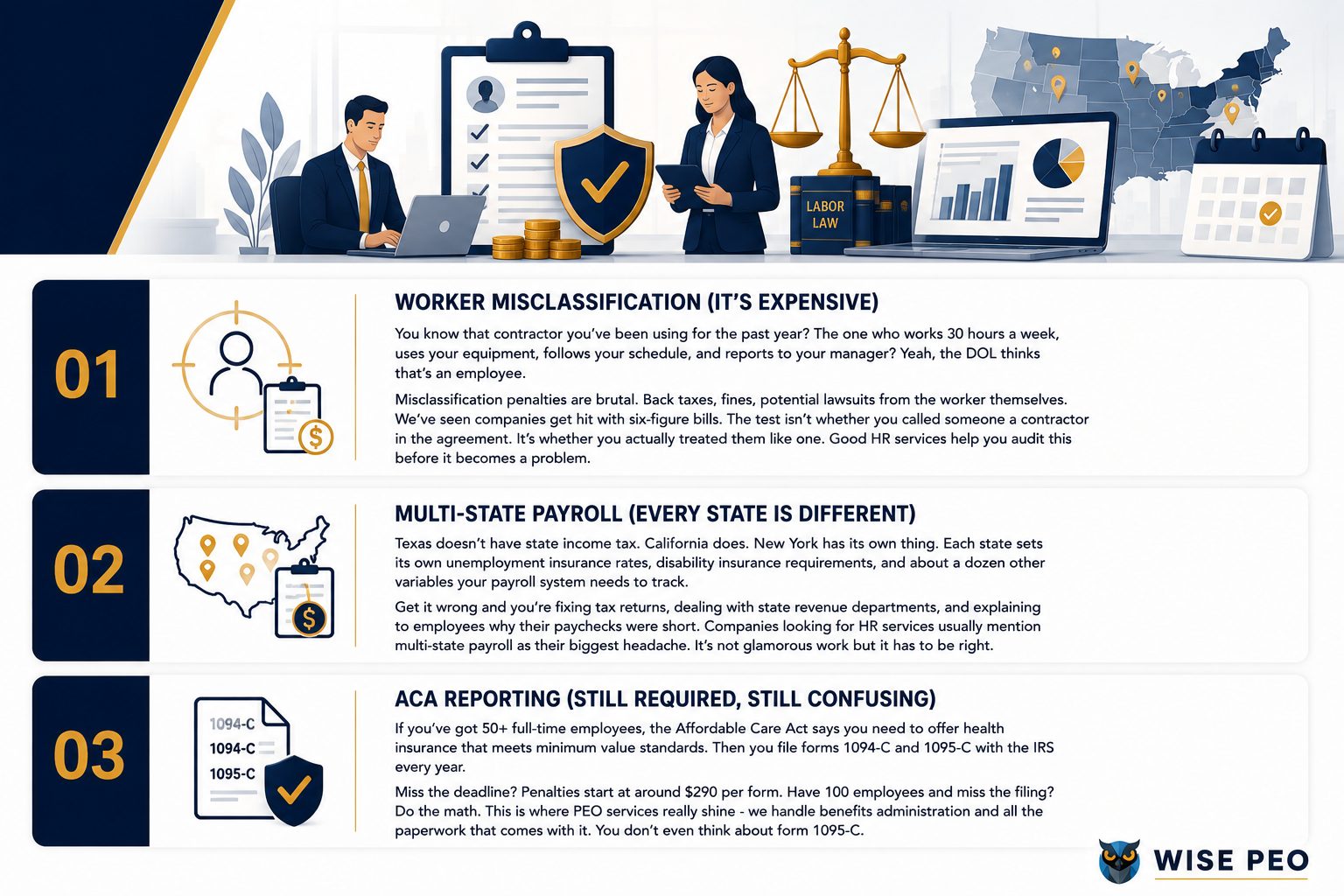
You know that contractor you’ve been using for the past year? The one who works 30 hours a week, uses your equipment, follows your schedule, and reports to your manager? Yeah, the DOL thinks that’s an employee.
Misclassification penalties are brutal. Back taxes, fines, potential lawsuits from the worker themselves. We’ve seen companies get hit with six-figure bills. The test isn’t whether you called someone a contractor in the agreement. It’s whether you actually treated them like one. Good HR services help you audit this before it becomes a problem.
Multi-State Payroll (Every State Is Different)
Texas doesn’t have state income tax. California does. New York has its own thing. Each state sets its own unemployment insurance rates, disability insurance requirements, and about a dozen other variables your payroll system needs to track.
Get it wrong and you’re fixing tax returns, dealing with state revenue departments, and explaining to employees why their paychecks were short. Companies looking for HR services usually mention multi-state payroll as their biggest headache. It’s not glamorous work but it has to be right.
ACA Reporting (Still Required, Still Confusing)
If you’ve got 50+ full-time employees, the Affordable Care Act says you need to offer health insurance that meets minimum value standards. Then you file forms 1094-C and 1095-C with the IRS every year.
Miss the deadline? Penalties start at around $290 per form. Have 100 employees and miss the filing? Do the math. This is where PEO services really shine – we handle benefits administration and all the paperwork that comes with it. You don’t even think about form 1095-C.
OSHA Compliance
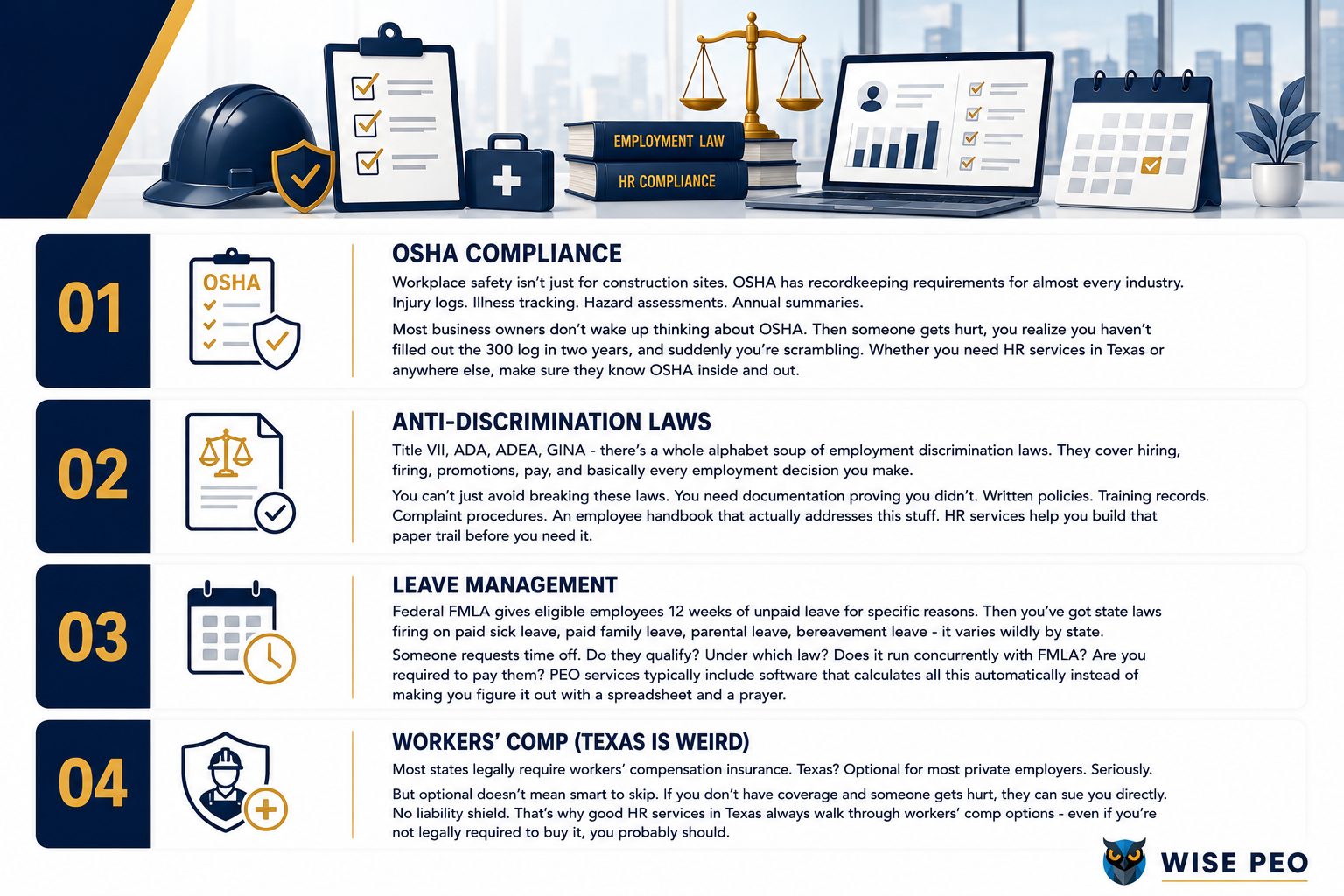
Workplace safety isn’t just for construction sites. OSHA has recordkeeping requirements for almost every industry. Injury logs. Illness tracking. Hazard assessments. Annual summaries.
Most business owners don’t wake up thinking about OSHA. Then someone gets hurt, you realize you haven’t filled out the 300 log in two years, and suddenly you’re scrambling. Whether you need HR services in Texas or anywhere else, make sure they know OSHA inside and out.
Anti-Discrimination Laws
Title VII, ADA, ADEA, GINA – there’s a whole alphabet soup of employment discrimination laws. They cover hiring, firing, promotions, pay, and basically every employment decision you make.
You can’t just avoid breaking these laws. You need documentation proving you didn’t. Written policies. Training records. Complaint procedures. An employee handbook that actually addresses this stuff. HR services help you build that paper trail before you need it.
Leave Management
Federal FMLA gives eligible employees 12 weeks of unpaid leave for specific reasons. Then you’ve got state laws piling on paid sick leave, paid family leave, parental leave, bereavement leave – it varies wildly by state.
Someone requests time off. Do they qualify? Under which law? Does it run concurrently with FMLA? Are you required to pay them? PEO services typically include software that calculates all this automatically instead of making you figure it out with a spreadsheet and a prayer.
Workers’ Comp (Texas Is Weird)
Most states legally require workers’ compensation insurance. Texas? Optional for most private employers. Seriously.
But optional doesn’t mean smart to skip. If you don’t have coverage and someone gets hurt, they can sue you directly. No liability shield. That’s why good HR services in Texas always walk through workers’ comp options – even if you’re not legally required to buy it, you probably should.
What We Actually Do
We’re PEO. That means we partner with your business through what’s called co-employment. You stay in charge of your company, your employees, your day-to-day operations. We handle the HR infrastructure – payroll, benefits, compliance, risk management.
Here’s how it works in practice: Your employee in Dallas has a question about FMLA leave. They email us, not you. Your Colorado employee needs to update their W-4. We handle it. The DOL issues new overtime guidance. We read the 47-page document, update our systems, and send you a two-paragraph summary of what changed.
Our HR services cover all the stuff we just talked about. Multi-state payroll. Benefits administration. Compliance monitoring. Workers’ comp. We’re not trying to replace you. We’re taking the administrative burden off your plate so you can focus on actually running your business.
For companies in Texas specifically – and we work with a lot of them – our HR services in Texas address both the federal requirements everyone deals with and the Texas-specific quirks. Like how workers’ comp is optional. Or how Texas wage payment laws differ from other states. Little details that matter when the TWC comes asking questions.
Through PEO services, you also get access to better benefits pricing. We pool together all our client companies, which gives us negotiating power with insurance carriers. Your 20-person company gets the same health insurance rates as a 500-person company. That’s not nothing.
Mistakes We See All the Time
Assuming State Laws Are Similar
They’re not. California has completely different meal break rules than Texas. New York’s paid sick leave doesn’t look like Florida’s. What works for your Austin office will get you in trouble in Seattle.
We see this constantly – companies apply their home state’s rules everywhere and assume it’s fine. Then they get a demand letter from an employee in another state claiming wage violations. Don’t guess. Either learn each state’s requirements or find HR services that already know them.
Running Without Written Policies
“We have a casual culture’ doesn’t hold up in court. You need an employee handbook. Written PTO policy. Documented discipline procedures. Harassment complaint process on paper.
When employment disputes happen – and they will – the first question is always ‘what does your policy say?’ If the answer is ‘uh, we don’t really have one,’ you’ve already lost credibility.
Fixing Problems Reactively
Compliance isn’t something you address after getting a penalty notice. That’s like studying for the test while taking it. By the time the DOL shows up for an audit, your options are limited and expensive.
Good HR services run periodic audits. Check your I-9s before ICE does. Review your exempt classifications before the DOL does. Fix your OSHA logs before OSHA asks to see them.
Trusting Labels Over Reality
Your contract says ‘independent contractor’ so they must be one, right? Wrong. The employment relationship determines classification, not the paperwork. If someone works your hours, at your location, with your tools, following your instructions – congratulations, you have an employee. The DOL doesn’t care what you called them.
Figure Out Where You Stand
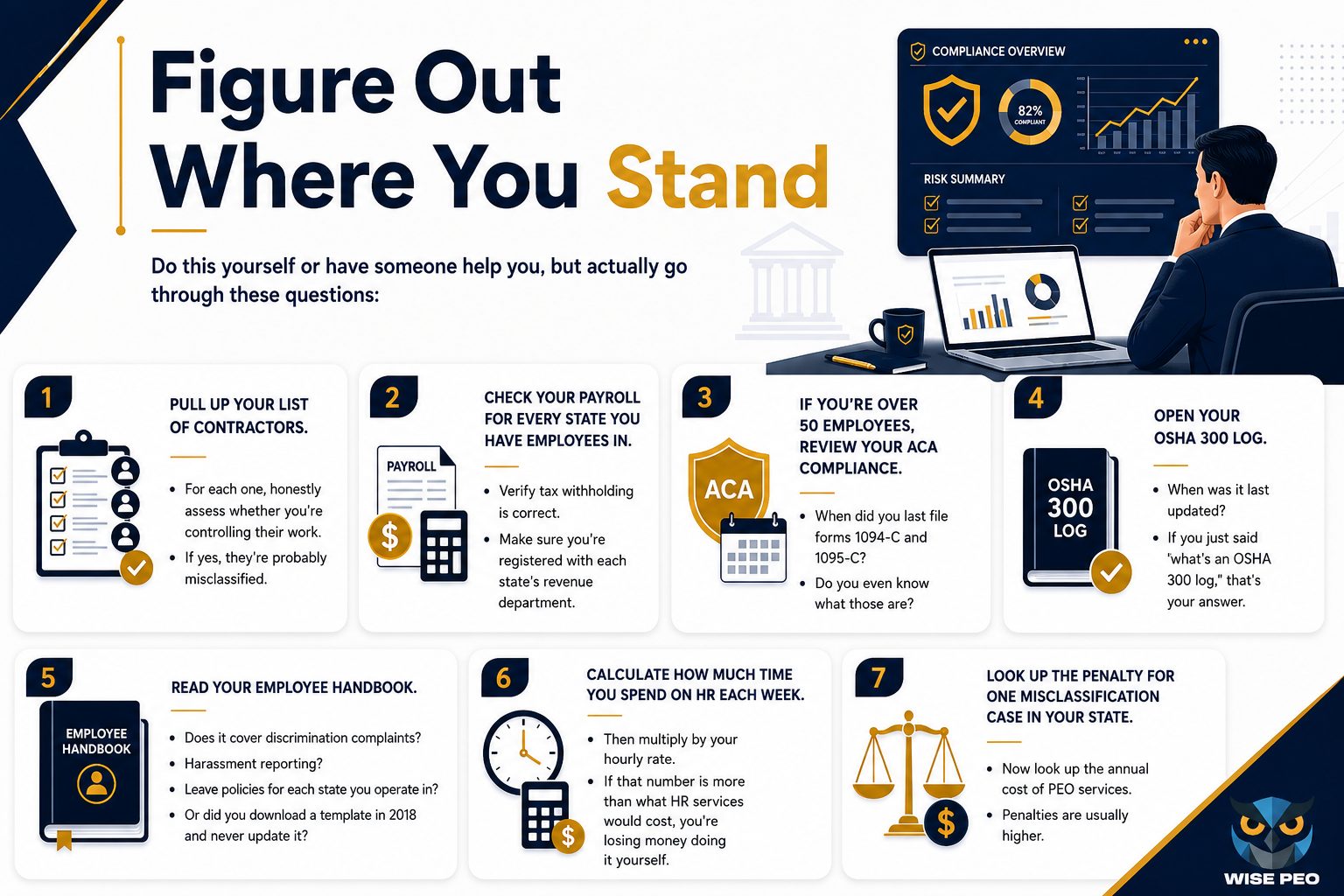
Do this yourself or have someone help you, but actually go through these questions:
1. Pull up your list of contractors. For each one, honestly assess whether you’re controlling their work. If yes, they’re probably misclassified.
2. Check your payroll for every state you have employees in. Verify tax withholding is correct. Make sure you’re registered with each state’s revenue department.
3. If you’re over 50 employees, review your ACA compliance. When did you last file forms 1094-C and 1095-C? Do you even know what those are?
4. Open your OSHA 300 log. When was it last updated? If you just said ‘what’s an OSHA 300 log,’ that’s your answer.
5. Read your employee handbook. Does it cover discrimination complaints? Harassment reporting? Leave policies for each state you operate in? Or did you download a template in 2018 and never update it?
6. Calculate how much time you spend on HR each week. Then multiply by your hourly rate. If that number is more than what HR services would cost, you’re losing money doing it yourself.
7. Look up the penalty for one misclassification case in your state. Now look up the annual cost of PEO services. Penalties are usually higher.
When to Call Us
You don’t need to be on fire to reach out. But here are the situations where companies typically realize they need help:
• You hired someone in a new state and just realized you have no idea how to handle their payroll correctly.
• You’re spending 10+ hours a week on HR tasks and you’re the CEO. That’s a problem.
• Your health insurance renewal came back with a 30% increase and you can’t afford it.
• An employee asked about FMLA and you had to google what that means.
• You’re in Texas (or anywhere really) and you’re not confident your compliance is bulletproof.
Look, PEO services aren’t for everyone. If you’ve got 5 employees all in one state and a simple operation, you probably don’t need us yet. But if you’re growing, hiring remotely, or just tired of being your own HR department, let’s talk.
Bottom Line
HR compliance in 2026 requires staying current with changing regulations, understanding state-by-state differences, and maintaining documentation that’ll hold up under audit. You can do it yourself. Lots of companies do.
But most companies that go that route eventually hit a wall. The complexity scales faster than their internal capacity. They make a mistake. They get a penalty. They realize the cost of proper HR services would’ve been less than the cost of fixing the problem.
At Wise PEO, we handle the HR infrastructure so you can focus on your actual business. Payroll. Benefits. Compliance. Risk management. All the stuff that has to get done but doesn’t directly generate revenue.
If you need HR services in Texas or help managing multi-state compliance, visit wisepeo.com. We’ll walk through your situation and figure out if PEO services make sense for you. No pressure, no sales pitch. Just an honest conversation about what you need.
As compliance requirements continue evolving, many companies are turning to HR outsourcing for expert guidance and administrative support. Learn more in “Human Resources Outsourcing: Complete Guide for Growing Businesses.”
Questions We Get Asked
It’s following the employment laws that govern how you hire people, pay them, and manage the workplace. Federal laws like the Fair Labor Standards Act. State laws that vary wildly. Industry-specific regulations if you’re in healthcare or finance. It matters because violations aren’t just embarrassing – they’re expensive. Penalties, back pay, lawsuits. Better to get it right the first time.
We run your payroll so taxes get withheld correctly. We handle benefits enrollment and ACA reporting. We maintain your OSHA logs and I-9 forms. We update your employee handbook when laws change. Basically, all the compliance tasks that have to happen but that you probably don’t enjoy doing. Our HR services take them off your plate.
Yes. Employment laws don’t have a ‘you’re too small to matter’ exemption. Some requirements kick in at certain employee counts – ACA at 50, FMLA at 50 – but wage and hour laws, anti-discrimination protections, and tax withholding apply to everyone. Even a 3-person company needs to get payroll taxes right.
A couple of things. Workers’ comp is optional for most private employers, that’s basically just Texas. No state income tax, which simplifies payroll but doesn’t eliminate federal requirements. Specific wage payment laws about when you have to pay final paychecks. If you’re running a business here, HR services in Texas should understand these quirks without you having to explain them.
When you’re spending more time managing HR than you want to. When you’re hiring in multiple states and the complexity is getting out of hand. When you’ve realized you can’t afford a full-time HR person but you need more than payroll software. When you got a compliance scare and decided you don’t want to go through that again. PEO services work well for companies between roughly 10-250 employees.
Department of Labor audits for wage violations. EEOC complaints for discrimination. IRS penalties for payroll tax mistakes. OSHA fines for safety violations. Lawsuits from misclassified workers. Most of these come with both financial penalties and the requirement to fix everything going forward. It’s cheaper and less stressful to have proper HR services handling it correctly from the start.
Both. Benefits administration is part of our PEO services, we manage enrollment, handle carrier relationships, and file all the required reports. We also get you access to better rates through group purchasing. Your 20-person company pays what a 200-person company pays. Plus we deal with the insurance brokers so you don’t have to.
Go through the checklist we outlined above. If you can’t confidently answer questions about your worker classifications, multi-state payroll, ACA reporting, OSHA logs, and employee handbook, you’ve got gaps. Most companies do. That’s not unusual. The question is whether you want to fix them yourself or bring in HR services to handle it. Either way, fix them before they become problems.