
You started your business because you’re good at something specific. Maybe it’s software development, or construction, or running a medical practice, or selling products online.
You definitely didn’t start it because you wanted to become an expert on Texas unemployment insurance regulations. Or spend your Friday afternoon on hold with the IRS trying to figure out why your payroll tax deposit got flagged.
But here we are.
If you’ve got somewhere between 10 and 150 employees, I’m willing to bet you’re spending at least 10 to 20 hours every single week dealing with HR stuff that has absolutely nothing to do with why you went into business in the first place. Payroll. Benefits. Compliance. Employee handbooks. Workers’ comp claims. The list just keeps growing.
The real question isn’t whether you need HR services. It’s whether you keep trying to figure it out yourself, or whether you hand it off to people who actually do this for a living.
This guide is going to walk through what HR outsourcing services actually mean (not the marketing version, the real version), when it makes sense financially, how to figure out if a provider is any good, and why a lot of growing businesses across Texas are working with Professional Employer Organizations like Wise PEO instead of trying to build their own HR department.
Why This Whole Thing Matters
The rules changed, really changed, not just minor tweaks.
What worked in 2020 doesn’t cut it anymore. What was probably fine in 2023 might get you in trouble in 2026.
The Compliance Situation Got Complicated Fast
Remember when the Department of Labor updated the salary threshold for overtime exemptions? Yeah, that happened again. And then it kept adjusting. If you haven’t looked at your employee classifications lately, there’s a decent chance you’re sitting on some potential back-pay liability you don’t even know about yet.
The Affordable Care Act isn’t going anywhere. If you’ve got 50 or more full-time equivalent employees (and yes, that calculation is more annoying than it sounds), you have to offer health coverage that meets very specific standards. You have to track hours. You have to file Form 1095-C and Form 1094-C. The penalties for screwing this up can hit $3,000 per employee. Per year.
And then there’s the state stuff, which is where things get really messy for HR services in Texas and beyond.
More than a dozen states now have their own paid family and medical leave programs that go way beyond what federal FMLA requires. California, New York, Washington, Colorado, Connecticut, Massachusetts, Oregon. If you’ve got employees in any of those states, you’re dealing with separate contribution requirements, different accrual rules, and reporting obligations that don’t exist at the federal level.
Immigration enforcement picked up significantly in 2025 and it’s still going strong. I-9 audits went from “maybe someday” to “this could happen to us” for a lot of businesses. The remote verification flexibilities from the pandemic? Those ended. If your I-9 documentation isn’t clean, you’re looking at civil penalties that can add up fast.
And Then There’s the Multi-State Employment Thing
Remote work isn’t temporary anymore. It’s just how a lot of businesses operate now.
The second you hire someone who lives in a different state, everything gets more complicated. You have to register for unemployment insurance in that state. You have to withhold state income taxes according to their rules. You have to track whether that state has paid leave laws, higher minimum wage requirements, or meal break rules that don’t exist where you’re based.
If your business is in Texas but you’ve got a developer in California or an accountant in New York, guess what? You’re now subject to California employment law and New York employment law for those specific employees. The compliance requirements just multiply.
This is the part where HR outsourcing services stop being a nice-to-have and start being pretty much necessary if you want to sleep at night.
So What Actually Is HR Outsourcing and How Does This Work?
Alright, let’s clear this up because there’s a lot of confusion about what outsourcing HR actually means.
Basically, you’re taking some or all of your HR functions and handing them to an outside company that specializes in this stuff. Instead of hiring someone internally to run payroll and manage benefits (or worse, making your office manager do it on top of everything else they’re already doing), you partner with a firm that does nothing but provide HR services all day long.
The most complete version of this is working with a Professional Employer Organization. That’s the PEO thing you’ve probably heard about.
What Co-Employment Actually Means
Here’s what freaks people out: when you work with a PEO, they become the “co-employer” of your team.
That sounds like you’re losing control of your business. You’re not.
You still run everything. You decide who to hire, who to fire, how much to pay people, what projects they work on, when they take vacation. All the actual business decisions? Those are still 100% yours.
What the PEO does is become the employer of record for tax and compliance purposes. They file payroll taxes under their EIN. They sponsor the health insurance plans. They take on shared legal responsibility for certain employment law compliance.
Think of it this way: you keep running the business, they handle the paperwork and regulatory stuff. That’s one of the core PEO benefits that makes this model work for growing companies.
What Can You Actually Outsource?
Most businesses working with a PEO for HR services hand off these things:
Payroll processing and all the tax stuff: That’s calculating paychecks, withholding the right amounts for federal and state taxes, making the tax deposits on time, filing quarterly returns, dealing with garnishments, printing W-2s at the end of the year. Quality payroll compliance services guarantee it’s done right and the provider is on the hook if something goes wrong.
Benefits: The PEO sponsors health insurance, dental, vision, life insurance, disability coverage, and 401(k) plans. Your employees get access to the same quality benefits that much larger companies offer, because you’re joining the PEO’s big group. They handle enrollment, changes, COBRA administration, all of it. This is a major PEO benefit for small businesses.
HR compliance for small businesses: The PEO keeps track of changes in employment law at the federal, state, and local level. They update your employee handbook. They make sure you’ve got the right posters up. They help you figure out FMLA requests, ADA accommodations, and how to handle terminations without getting sued.
Workers’ comp: Most PEOs include workers’ compensation insurance as part of the package. They manage claims, help injured employees get back to work, and work on keeping your experience mod down.
Employee relations support: You get access to actual HR professionals who can walk you through performance issues, disciplinary situations, employee complaints, and workplace investigations.
Safety programs and risk management: They provide templates, training resources, and advice on keeping your workplace safe and reducing liability.
What You Don’t Outsource
Your business strategy. Product development. Sales. Customer relationships. Management decisions.
You’re still the one deciding who to hire, what to pay them, when to promote them, when to let them go. You set the work schedule, assign projects, and evaluate performance.
The PEO handles the compliance, the paperwork, the administrative stuff that needs to happen to support all those decisions.
How Wise PEO Actually Handles This for Growing Businesses
Most business owners mess this up when they start looking at HR outsourcing services. They get a few quotes, compare the monthly fees, and pick the cheapest one.
That’s not how this should work.
Wise PEO starts by actually understanding your situation. What’s your workforce structure look like? Where are you trying to go in the next couple years? What compliance stuff keeps you up at night? What are the specific things eating up your time?
Only after we understand all that do we talk about whether we’re a good fit and what it would actually cost.
Payroll Compliance Services Across All 50 States
If all your employees are in Texas, payroll is relatively straightforward. No state income tax, which helps. But you’ve still got quarterly unemployment filings, annual reconciliations, and the possibility of a state audit. HR services in Texas still need to handle all the federal requirements plus state-specific regulations.
Hire one remote worker in California? Or Colorado? Or New York? Now you’re dealing with an entirely different tax system. You need to register with that state’s tax authority. Set up withholding. Learn their specific wage and hour rules. Track their leave entitlements.
Wise PEO manages all of that. We handle the new state registrations. We calculate withholding correctly for every jurisdiction. We make the tax deposits on time. We file the returns. If a tax agency sends you a notice, we handle it. You’re not spending three hours on hold trying to explain something to a state tax auditor.
Our payroll compliance services cover every state where you might hire, not just where you’re headquartered.
HR Compliance for Small Business Without Hiring a Full-Time HR Director
You know what a full-time HR director costs? Somewhere between $80,000 and $130,000 a year before you factor in benefits and payroll taxes. And that person has to stay current on employment law changes in every single state where you have employees. They need training, legal update subscriptions, and often outside attorney support for the complicated stuff.
For most businesses under 100 employees, that math doesn’t work.
With Wise PEO’s HR services, you get access to a whole team of HR professionals for a fraction of that cost. These are people who deal with FLSA classifications, ACA compliance, FMLA rules, reasonable accommodation requests, and termination procedures every single day.
When you’ve got an employee situation you’re not sure how to handle, you call your Wise PEO advisor. We talk through it. We look at the documentation. We tell you exactly what you should do to stay compliant and minimize risk.
You’re not guessing. You’re not hoping you got it right. That’s what real HR compliance for small businesses looks like.
The Benefits Thing (Which Is Actually a Huge Deal)
This might be the single biggest PEO benefit, and a lot of people don’t realize it until they see the actual numbers.
Small businesses get destroyed on health insurance pricing. You don’t have leverage with insurance carriers. You’re a group of 15 or 25 or 40 people. The rates you get offered are significantly worse than what large companies pay for the same coverage.
Through Wise PEO’s co-employment model, your employees join a much bigger group. We’re negotiating with carriers on behalf of thousands of employees across hundreds of client companies. That scale matters. It drives rates down and plan quality up.
Your 25-person company can offer the exact same medical, dental, and vision plans that a company with 5,000 employees offers. Same carriers, same networks, same coverage. Better rates than you’d ever get on your own.
This isn’t theoretical. When you’re competing for talent against bigger companies, benefits are often the deciding factor. Candidates take the job with better health insurance and a 401(k) match. Wise PEO puts you on equal footing.
The Technology Platform (Because Nobody Wants to Log Into Five Different Systems)
Wise PEO gives you one integrated platform for everything. Employees can pull up their pay stubs, update their direct deposit, enroll in benefits, request time off, and read company policies. Managers approve timecards and PTO requests online.
You can see real-time reporting on headcount, payroll costs, benefits utilization, turnover. It’s all in one place. You’re not juggling separate logins for payroll, benefits admin, time tracking, and compliance documentation.
The system tracks ACA hours automatically. It flags employees who are approaching full-time status. It generates the reports you need for ACA filing without building spreadsheets manually.
Here’s How to Actually Evaluate HR Outsourcing Services
Picking the wrong provider can make things worse instead of better. Here’s how to do this properly.
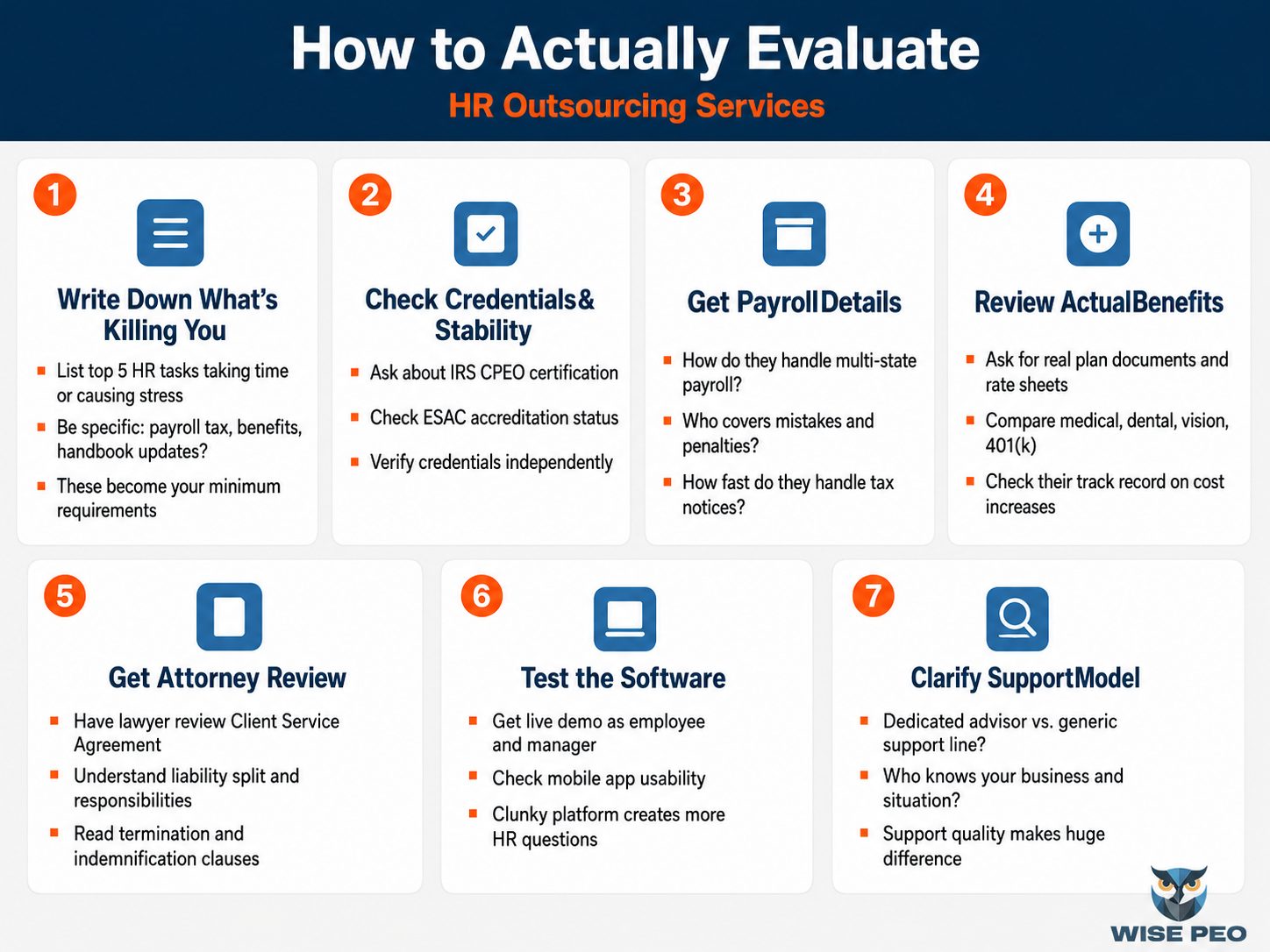
Step 1: Write Down What’s Actually Killing You Right Now
Make a list of the top five HR tasks that are either taking up the most time or causing the most stress. Be specific.
Is it multi-state payroll tax filings? Benefits renewal every year? Keeping the employee handbook updated? Dealing with unemployment claims? Figuring out FMLA requests?
This list becomes your minimum requirements. If a provider’s HR services can’t solve these exact problems, they’re not the right fit for you.
Step 2: Check Credentials and Financial Stability
Ask if the provider is an IRS Certified Professional Employer Organization (CPEO). CPEO certification means they’ve met serious financial and operational standards set by the IRS. It gives you extra protection on payroll tax liability.
Also ask about ESAC accreditation (Employer Services Assurance Corporation). That’s another verification that they follow best practices in finance, operations, and client service.
Not every PEO has these credentials. Some excellent providers operate without CPEO certification but maintain strong financial controls and service quality through other means. What matters is understanding how the provider protects you and what guarantees they offer.
And here’s the important part: verify credentials independently if they claim to have them. Don’t just take their word for it. Contact the IRS or ESAC directly and confirm the certification status.
Step 3: Get Into the Details on Payroll Compliance Services
Ask specifically how they handle multi-state payroll. Can they register your business in any state where you might hire? What about local taxes like city or school district taxes?
Ask what happens if they make a mistake. Do they guarantee accuracy? If their error causes penalties or interest, do they cover it?
Ask how they handle tax notices. If the IRS or a state agency sends a letter, who deals with it? How fast? Do you ever have to talk to tax agencies yourself or do the payroll compliance services handle all of that?
These details matter a lot when something actually goes wrong.
Step 4: Make Them Show You the Actual Benefits
Don’t accept vague promises about “competitive benefits.” Ask for real plan documents and rate sheets. This is where you see the real PEO benefits.
Compare the medical plans to what you have now or what your competitors offer. Look at deductibles, out-of-pocket maximums, prescription coverage, provider networks.
Check out the dental and vision details. Look at the 401(k) plan, the investment options, the fees.
Ask how benefits costs work. Are the premiums fully insured? How do renewals work? What’s their track record on year-over-year cost increases?
Step 5: Have Your Attorney Look at the Contract
Get a lawyer to review the Client Service Agreement before you sign anything. Pay attention to which employer responsibilities stay with you and which transfer to the PEO.
Understand the liability split for workers’ comp, employment practices claims, wage and hour violations, payroll tax deposits.
Look at the termination provisions. What’s the notice period if you want to leave? What happens to all your employee data? How does benefits coverage transition?
Read the indemnification clauses carefully. Make sure you’re not signing away protections you actually need.
Step 6: Actually Test the Software
Get a live demo of their HRIS and payroll system. Log in as both an employee and a manager if they’ll let you.
Can employees easily pull up pay stubs, tax forms, benefits info? Can they request time off and update personal information without calling someone?
Can managers approve timecards, see team schedules, run basic reports? Is the mobile app actually usable or is it frustrating?
If the platform is clunky, your team is going to hate it. That creates more HR questions, not fewer.
Step 7: Figure Out What Support Actually Looks Like
There’s a massive difference between having a dedicated advisor who knows your business and calling a generic support line where you explain your situation from scratch every time.
Ask if you get a named contact. How fast do they respond? Do you get a real person or voicemail? Can you schedule calls for complex issues?
Ask what happens if your advisor can’t answer something. Do you get bounced around or does someone with deeper expertise call you back?
The quality of ongoing support is what makes or breaks an HR outsourcing services relationship.
The Mistakes Businesses Make When Choosing HR Outsourcing Services
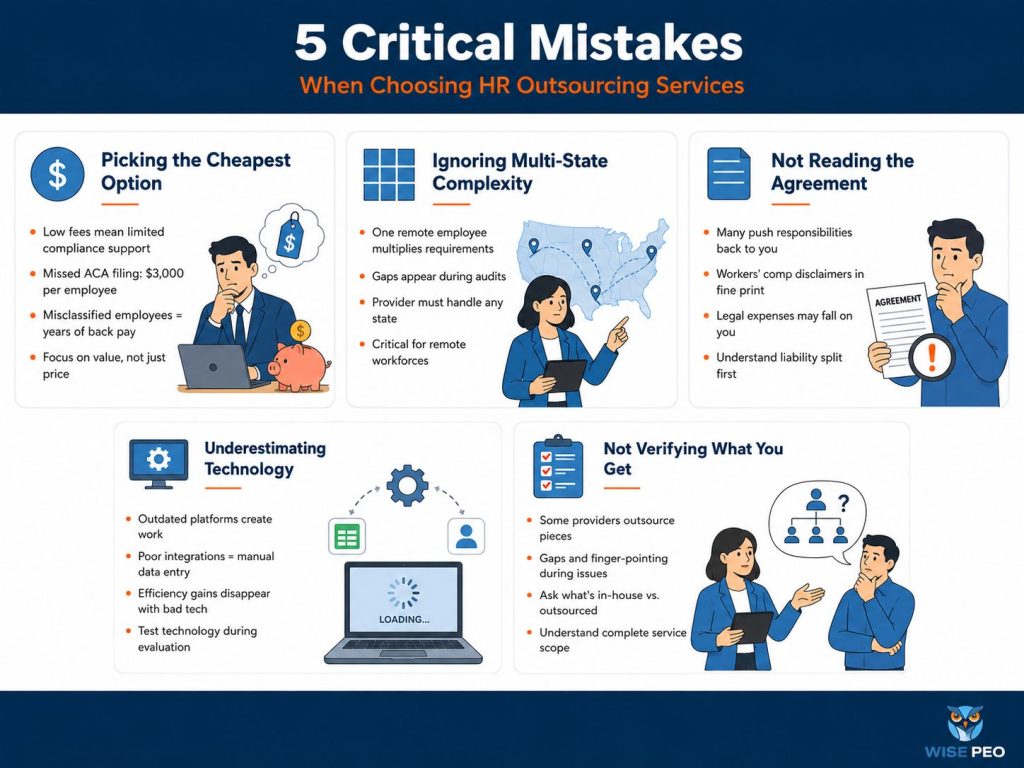
Picking the Cheapest Option
The cheapest provider is almost never the best one. Low fees usually mean limited compliance support, mediocre benefits carriers, bad technology, or high client turnover (which should tell you something).
When a compliance failure hits, the cheap option gets real expensive real fast. A missed ACA filing costs $3,000 per employee. A misclassified exempt employee triggers years of back overtime. A termination handled wrong turns into a lawsuit.
Look at value and risk reduction, not just the monthly bill.
Ignoring Multi-State Complexity
If you’ve got even one remote employee in another state, your compliance requirements multiply. Businesses that pick HR services without strong multi-state capabilities find gaps later.
Those gaps show up during unemployment audits, when former employees file claims, or when you’re trying to get business licenses in new states.
Make sure the provider can handle any state where you might hire, not just where you’re based today. This is especially important for HR services in Texas if you’re hiring remote workers in other states.
Not Reading the Agreement
A lot of business owners sign contracts without really understanding the liability split. Some agreements push significant responsibilities back to you in disputes or claims.
For example, some providers disclaim responsibility for workers’ comp claims if they later decide the claim wasn’t reported correctly. Others have broad indemnification clauses that shift legal costs back to you.
Know what you’re agreeing to before you commit.
Underestimating How Much the Technology Matters
An outdated platform creates work instead of eliminating it. Employees who can’t easily access their information just ask you instead.
If the system doesn’t integrate with your time tracking or accounting software, you’re manually importing data every pay period. That wipes out most of the efficiency you were expecting.
Test the technology seriously during your evaluation.
Forgetting to Verify What You’re Actually Getting
Some companies market themselves as full-service HR providers without actually delivering comprehensive payroll compliance services or HR compliance for small businesses. They might outsource pieces to other vendors, which creates gaps and finger-pointing when issues arise.
Ask specifically what’s handled in-house versus subcontracted. Understand the full scope of what you’re getting.
What the Best Clients Do Differently
After working with hundreds of growing businesses, Wise PEO has noticed some patterns. The clients who get the most value from HR outsourcing services do a few things differently than everyone else.
They Use the Expertise Proactively Instead of Waiting for Problems
The best clients schedule regular check-ins with their HR advisor. Maybe quarterly. They talk about upcoming workforce changes, ask about compliance updates in their industry, review handbook policies once a year.
They don’t wait until an employee files a complaint to ask about documentation. They build good practices before problems show up.
Being proactive about this stuff gets you way more value out of the partnership.
They Actually Talk About Benefits During Hiring
Wise PEO clients who actively promote their health insurance and 401(k) during the recruiting process see better results. Measurably better.
They include benefits summaries in offer letters. They talk about health insurance quality during interviews. They compare their plans to what competitors offer.
Access to good benefits is a real PEO benefit. Use it intentionally when you’re hiring.
They Keep Their Data Clean
Payroll compliance services only work if the data you provide is accurate. Good job classifications, consistent time tracking, complete onboarding information. That stuff matters.
Build systems for collecting employee information correctly the first time. Train managers on time approval workflows. Create new hire checklists that capture everything upfront.
Clean data means fewer errors, faster payroll, better compliance.
They Think About Exit Terms Before Signing
What happens if your business grows to the point where bringing HR in-house makes sense? What if you merge with another company using different HR services?
Ask about data portability before you sign. Can you export employee records, payroll history, benefits information in formats you can actually use? Does the provider help with transitions or make leaving difficult?
Understand these terms upfront, not when you’re trying to leave.
They Use Everything the Provider Offers
Many HR outsourcing services include resources beyond the core offerings. Access to employment attorneys, safety consultants, HR tech vendors, insurance brokers.
Ask what’s included and what costs extra. Take advantage of training webinars, compliance alerts, template libraries.
The more resources you actually use, the better the return on what you’re paying.
When You Know It’s Time to Outsource HR Services
Not every business needs comprehensive HR outsourcing services from day one. But there’s usually a clear point where not outsourcing starts costing you more than outsourcing would.
Here’s how you know you’ve reached that point.
You’re spending more than 10 hours a week on HR instead of actually running the business. If payroll, benefits, and compliance are eating up significant leadership time, you’ve outgrown doing it yourself.
You’ve hired or you’re about to hire employees in multiple states. Multi-state compliance is complicated enough that most businesses can’t manage it efficiently without professional payroll compliance services.
You’ve lost good candidates to bigger competitors who offered better benefits. If benefits are costing you talent, the PEO benefits model solves that.
You got a payroll tax notice or a DOL inquiry that took forever to deal with. Compliance issues mean you’ve got gaps in your HR infrastructure.
You’ve got more than 15 employees and no dedicated HR person. At this size, the admin work is too much for founders or office managers to handle on top of everything else. You need real HR compliance for small businesses.
You’re preparing for funding or acquisition and you need clean HR records for due diligence. Investors and acquirers look hard at your employment practices. Working with quality HR services shows operational maturity.
You want better onboarding, performance management, or an employee handbook but you don’t have time to build that stuff. HR outsourcing services give you templates, processes, ongoing support.
If three or more of these describe your situation right now, you should probably talk to Wise PEO about HR services in Texas or wherever your business operates.
Final Thoughts
The best time to look at HR outsourcing services is before you’ve got a compliance crisis. Before you lose a key hire because they got better benefits somewhere else. Before multi-state payroll turns into a recurring nightmare.
The second best time is right now.
Picking the right HR services partner isn’t just about admin convenience. It’s a strategic decision about whether you want regulatory complexity slowing down your growth.
Quality HR outsourcing services reduce costs, limit legal risk, and free up your time to actually build the business. The PEO benefits include better employee benefits, comprehensive payroll compliance services, and expert HR compliance for small business support.
For companies across Texas and the rest of the country, Professional Employer Organizations like Wise PEO deliver real value. Our HR services in Texas and nationwide help small and mid-size businesses navigate modern employment law, provide competitive benefits that help you win talent, and build HR infrastructure that scales with your business.
The co-employment model we use is transparent, flexible, and built around your goals.
Here’s what to do next:
Schedule a free consultation at wisepeo.com to talk about your specific HR challenges and compliance risks.
Talk to a Wise PEO advisor about whether our HR outsourcing services make sense for where you are right now and where you’re headed.
Request a benefits comparison to see how what you offer now stacks up against the PEO benefits you could provide through our partnership.
Get a no-obligation review of your payroll compliance services to identify gaps before they turn into expensive problems.
The right HR services partnership turns administrative burden into competitive advantage. Let’s figure out if Wise PEO is the right fit for your business.
Frequently Asked Questions
HR outsourcing means handing some or all of your HR functions to an outside provider, usually a Professional Employer Organization. It matters for growing businesses because it gives you access to expert HR services, comprehensive benefits, and payroll compliance services without the cost of building an internal HR department. As your business scales, especially if you’re hiring across multiple states, HR complexity grows fast. Outsourcing lets you stay compliant, offer competitive benefits, and focus your time on revenue-generating activities instead of administrative tasks. The PEO benefits include risk reduction, better employee benefits access, and scalable support.
Texas doesn’t have state income tax, which simplifies some payroll aspects, but Texas employers still face quarterly unemployment insurance filings, annual reconciliations, and potential state audits. Where Texas HR services get complicated is when you hire remote workers in other states. The moment you have an employee in California, New York, or Colorado, you’re dealing with those states’ income tax withholding, paid leave programs, and wage and hour laws. Quality HR outsourcing services handle all those multi-state complexities so you don’t have to become an expert in 50 different state tax systems.
Professional payroll compliance services handle all aspects of payroll tax obligations across every state where you have employees. This includes calculating withholding correctly, making timely tax deposits, filing quarterly and annual returns, managing year-end W-2 processing, and responding to tax agency notices on your behalf. Good providers guarantee accuracy and cover penalties resulting from their errors. This protection is especially valuable for multi-state employers where compliance requirements multiply quickly. When you work with a PEO, the co-employment model means they share legal responsibility for payroll tax compliance.
The biggest PEO benefits are access to Fortune 500-level employee benefits at rates small businesses can’t negotiate independently, comprehensive HR compliance for small business without hiring expensive internal staff, guaranteed payroll compliance services across all states, workers’ compensation coverage with professional claims management, and dedicated HR expertise for handling employee relations issues. Through the co-employment model, your employees join a much larger benefits pool, which drives health insurance costs down and plan quality up. This is a genuine recruiting advantage when competing against larger companies for talent.
You need HR compliance for small business support if you’re spending significant time on HR administration, operating in multiple states, approaching 50 employees and the ACA threshold, have received any compliance notices or audit inquiries, lack confidence in your current employment practices, or are preparing for funding or acquisition due diligence. Warning signs include outdated or missing employee handbooks, uncertainty about FLSA classifications, manual benefits administration, poor I-9 documentation, or no formal process for handling employee complaints. Quality HR outsourcing services address all these gaps.
Start evaluating HR outsourcing services when you hit 10 to 15 employees and HR administration is consuming more than 10 hours of leadership time per week, when you hire your first remote employee in another state, when you lose a candidate to a competitor with better benefits, or when you receive any compliance notice that takes significant time to resolve. Don’t wait for a crisis. The best time to establish HR services is before problems force your hand. Many businesses find that once they cross 15 to 20 employees, the cost of not outsourcing, measured in compliance risk and lost productivity, exceeds the cost of working with a quality provider like Wise PEO.
Related Posts
When Should a Company Outsource HR?
Common HR Challenges Solved by PEOs
HR Compliance Checklist for US Businesses
How to Avoid HR Compliance Penalties
Managing Remote Teams: HR Best Practices
HR Services in Texas: What Makes Local Expertise Matter
HR Analytics: Metrics Every Business Should Track