
Running a growing business means dealing with HR problems you never expected. Payroll’s take longer each month. You can’t match the benefits bigger companies offer. Compliance questions keep piling up and Google isn’t helping.
These aren’t signs you’re doing something wrong. They’re signs your business outgrew DIY HR.
At Wise PEO, we see the same HR challenges across growing businesses. The problems are predictable. So are the solutions. This guide covers the most common HR headaches we solve and how professional HR services make them disappear.
Whether you’re in Texas or operating across multiple states, these challenges probably sound familiar.
Why HR Challenges Multiplied in 2026
HR used to be simpler. Process payroll, hand out W-2s, done. Not anymore.
Employment regulations expanded. The DOL keeps updating overtime rules. States rolled out competing paid leave programs. Worker classification standards got stricter. Remote work created compliance obligations in states you’ve never operated in.
Benefits expectations changed too. Candidates won’t consider jobs without health insurance. Retention depends on 401(k) matching. Dental and vision became standard, not perks.
For Texas businesses especially, expansion complicates everything. You know Texas employment law. But California? New York? Each state’s different, and the penalties for getting it wrong aren’t small.
That’s why the best PEO services exist. Not to replace what you’re doing. To handle what you can’t do efficiently anymore.
The Seven HR Challenges PEOs Actually Solve
Here are the problems that drive most companies to look for HR services.
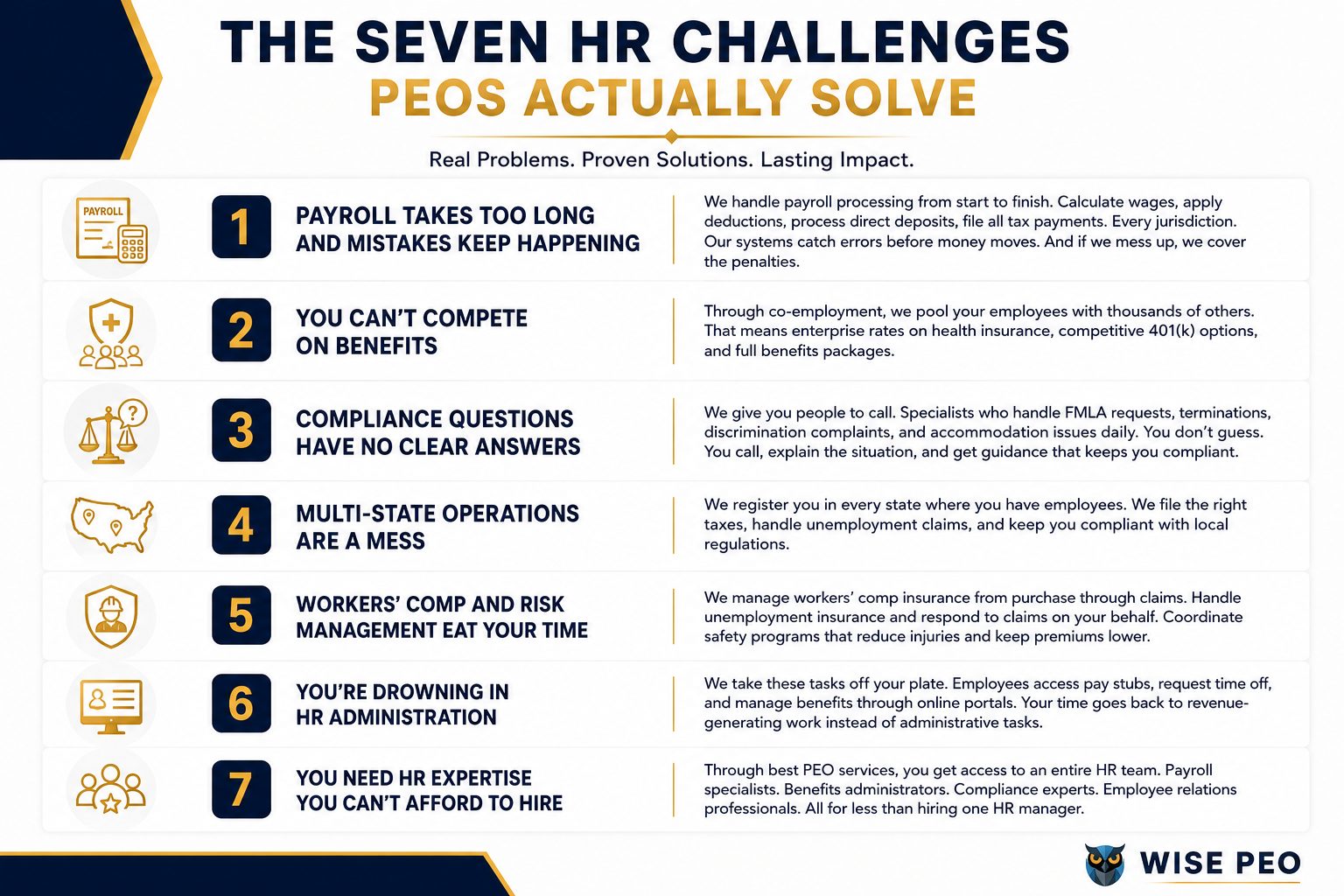
Challenge 1: Payroll Takes Too Long and Mistakes Keep Happening
Payroll starts simple. Five employees, one location, straightforward wages. Then you add shift differentials. Commission structures. Multi-state employees. Garnishment orders. Suddenly it’s a three-hour job every two weeks.
Mistakes creep in. Wrong tax withholding. Missed overtime calculations. Late direct deposits. Each error damages trust with your team and creates cleanup work.
We handle payroll processing from start to finish. Calculate wages, apply deductions, process direct deposits, file all tax payments. Federal, state, local. Every jurisdiction where you have employees.
Our systems catch errors before money moves. And if we mess up, we cover the penalties. Your team gets paid accurately, on time, every time.
Challenge 2: You Can’t Compete on Benefits
Good candidates are expensive to lose. They interview, you make an offer, they take another job. When you ask why, it’s always beneficial.
Small businesses get bad rates on health insurance. You’re paying more for worse coverage than big companies offer. No 401(k). Limited dental. No vision plans. It shows.
Through co-employment, we pool your employees with thousands of others. Insurance carriers see one large group instead of your small team. That means enterprise rates on health insurance, competitive 401(k) options, and full benefits packages.
Your 20-person company suddenly offers the same benefits as a 2,000-person company. Candidates notice. So do your current employees.
Challenge 3: Compliance Questions Have No Clear Answers
Employment law questions pile up. Can you require exempt employees to clock in? How do you handle religious accommodation requests? What documentation do you need before firing someone?
You search online. You get conflicting information. Federal law says one thing, your state says another. You’re not sure which applies or if there’s a local ordinance you’re missing.
Get it wrong and you’re dealing with the Department of Labor, EEOC complaints, or lawsuits. The cost isn’t just money, it’s time defending decisions you weren’t sure about in the first place.
We give you people to call. Specialists who handle FMLA requests, terminations, discrimination complaints, and accommodation issues daily. They know employment law and they’ve seen your situation before.
You don’t guess. You call, explain the situation, and get guidance that keeps you compliant.
Challenge 4: Multi-State Operations Are a Mess
You hire someone in another state. Suddenly you need to register with that state’s labor department, set up unemployment insurance, figure out their tax withholding rates, and understand their employment laws.
California has mandatory meal breaks. New York has paid sick leave. Each state has different overtime rules, minimum wages, and poster requirements. Multiply this by five states and it’s overwhelming.
HR services in Texas won’t help you comply with Colorado law. You need nationwide infrastructure.
We register you in every state where you have employees. We file the right taxes, handle unemployment claims, and keep you compliant with local regulations. Your remote worker in Arizona gets the same accurate payroll and compliance support as your Texas team.
Challenge 5: Workers’ Comp and Risk Management Eat Your Time
Someone gets hurt at work. You’re searching for the workers’ comp policy. Calling the insurance company. Filling out forms. Following up on the claim. Coordinating return-to-work.
Or unemployment claims. Former employees file. You respond with documentation. The state asks follow-up questions. Your unemployment tax rate goes up if you lose too many claims.
These situations demand immediate attention but you’re not equipped to handle them efficiently.
We manage workers’ comp insurance from purchase through claims. Handle unemployment insurance and respond to claims on your behalf. Coordinate safety programs that reduce injuries and keep premiums lower.
When problems happen, you call us. We handle it.
Challenge 6: You’re Drowning in HR Administration
Benefits enrollment takes a week. Someone needs their pay stub and you’re searching email. New hire paperwork sits on your desk waiting for time to process it. Employee handbooks need updating but you haven’t looked at them in two years.
HR tasks are never urgent until they are. Then they consume your day.
Track the time you spend on HR weekly. Payroll processing. Benefits questions. Policy updates. Employee relations issues. Compliance research. For most business owners, it’s 10-plus hours that could go toward actually running the business.
We take these tasks off your plate. Employees access pay stubs, request time off, and manage benefits through online portals. New hires complete paperwork digitally. Policy updates happen automatically when regulations change.
Your time goes back to revenue-generating work instead of administrative tasks.
Challenge 7: You Need HR Expertise You Can’t Afford to Hire
An experienced HR manager costs six figures. Plus benefits. Plus overhead. For a 30-person company, that’s tough to justify.
But you need HR expertise. Performance management systems. Compensation planning. Employee development programs. Termination procedures that minimize legal risk.
Without internal HR, you’re making decisions based on what sounds right, not what you know is legally compliant and strategically sound.
Through best PEO services, you get access to an entire HR team. Payroll specialists. Benefits administrators. Compliance experts. Employee relations professionals. All for less than hiring one HR manager.
You call with questions. They answer. That’s the value.
How Wise PEO Addresses These HR Challenges
We don’t just talk about solutions. Here’s what actually happens when you work with us.
Payroll runs automatically. Every pay period, on schedule, with direct deposit. We handle all tax filings, garnishments, and year-end reporting. Multi-state complexity doesn’t change the process, it’s built in.
Benefits enrollment happens through employee portals. Your team picks plans, makes changes during life events, and manages everything without calling you. We coordinate with insurance carriers and handle COBRA when people leave.
Compliance updates automatically. When overtime thresholds change, we update your policies. When new poster requirements come out, we send you the posters. When states implement new leave programs, we adjust your practices.
Questions get answered. Does the employee need FMLA? Call us. Performance issue needs documentation? Call us. Considering a termination? Call us first. We walk you through processes that keep you compliant.
Technology handles the routine stuff. Employees use mobile apps to check schedules, view pay stubs, and request time off. Managers approve requests digitally. Reports generate automatically.
That’s how HR services work when they’re done right. The administrative burden disappears. The compliance risk drops. You get your time back.
Want a deeper understanding of HR outsourcing solutions for growing businesses? Explore our pillar article: Human Resources Outsourcing: Complete Guide for Growing Businesses.
Four Mistakes Companies Make with HR Challenges
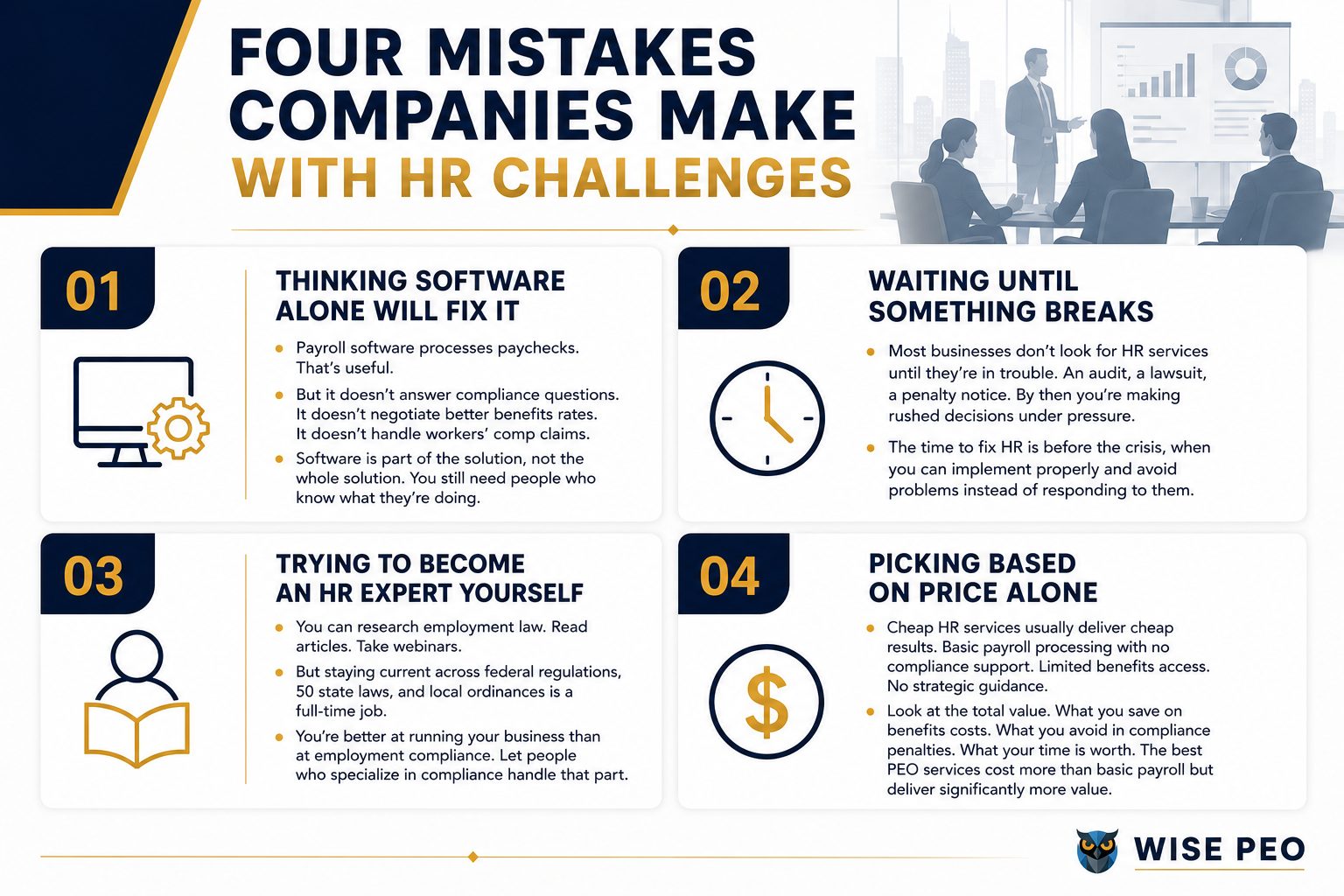
- Thinking Software Alone Will Fix It
Payroll software processes paychecks. That’s useful. But it doesn’t answer compliance questions. It doesn’t negotiate better benefits rates. It doesn’t handle workers’ comp claims.
Software is part of the solution, not the whole solution. You still need people who know what they’re doing.
- Waiting Until Something Breaks
Most businesses don’t look for HR services until they’re in trouble. An audit, a lawsuit, a penalty notice. By then you’re making rushed decisions under pressure.
The time to fix HR is before the crisis, when you can implement properly and avoid problems instead of responding to them.
- Trying to Become an HR Expert Yourself
You can research employment law. Read articles. Take webinars. But staying current across federal regulations, 50 state laws, and local ordinances is a full-time job.
You’re better at running your business than at employment compliance. Let people who specialize in compliance handle that part.
- Picking Based on Price Alone
Cheap HR services usually deliver cheap results. Basic payroll processing with no compliance support. Limited benefits access. No strategic guidance.
Look at the total value. What you save on benefits costs. What you avoid in compliance penalties. What your time is worth. The best PEO services cost more than basic payroll but deliver significantly more value.
How to Evaluate Whether You Need HR Services
Not sure if you’re ready for professional HR services? Here’s how to assess your situation.
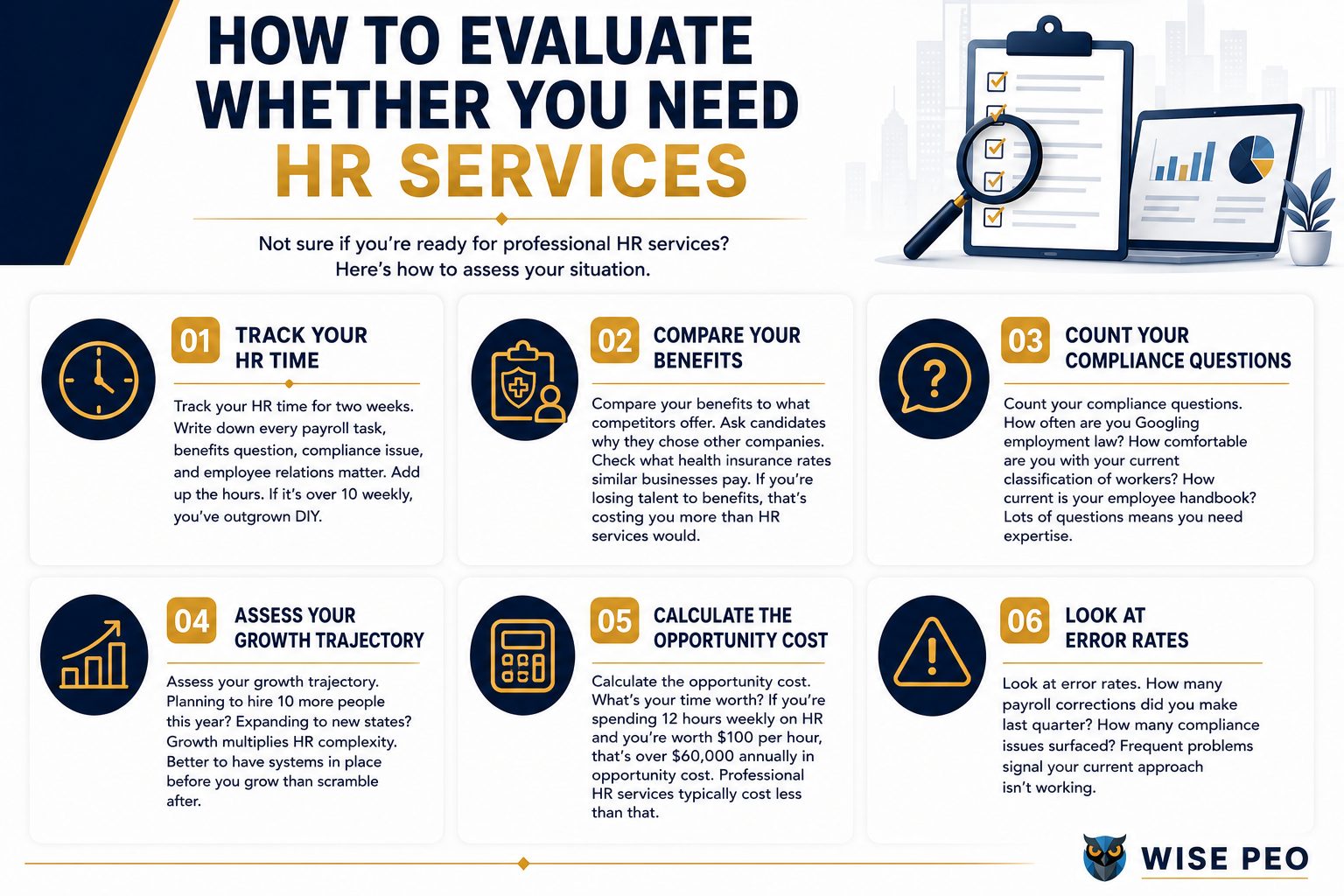
- Track your HR time for two weeks. Write down every payroll task, benefits question, compliance issue, and employee relations matter. Add up the hours. If it’s over 10 weekly, you’ve outgrown DIY.
- Compare your benefits to what competitors offer. Ask candidates why they chose other companies. Check what health insurance rates similar businesses pay. If you’re losing talent to benefits, that’s costing you more than HR services would.
- Count your compliance questions. How often are you Googling employment law? How comfortable are you with your current classification of workers? How current is your employee handbook? Lots of questions means you need expertise.
- Assess your growth trajectory. Planning to hire 10 more people this year? Expanding to new states? Growth multiplies HR complexity. Better to have systems in place before you grow than scramble after.
- Calculate the opportunity cost. What’s your time worth? If you’re spending 12 hours weekly on HR and you’re worth $100 per hour, that’s over $60,000 annually in opportunity cost. Professional HR services typically cost less than that.
- Look at error rates. How many payroll corrections did you make last quarter? How many compliance issues surfaced? Frequent problems signal your current approach isn’t working.
When Wise PEO Makes Sense for Your Business
We work best with companies facing specific situations.
You’re between 10 and 200 employees. Smaller than that, you can probably manage. Larger than that, you might need internal HR. That middle range is where professional HR services deliver the most value.
You operate in Texas but have employees elsewhere. We know Texas employment law thoroughly, but we also handle multi-state complexity without making you become an expert in 50 different regulatory systems.
Your leadership team is buried in HR tasks. If payroll, benefits questions, and compliance issues are consuming double-digit hours weekly, we free that time up for revenue-generating work.
You’re losing recruitment battles. Good candidates are choosing other companies because of benefits packages you can’t match independently. We fix that through aggregated buying power.
You want to grow without adding administrative overhead. Hiring 10 more employees means 10 more payroll records, benefits enrollments, and compliance obligations. With us, it just means 10 more employees, the rest scales automatically.
Facing recurring HR roadblocks? Discover how outsourcing can simplify hiring, compliance, payroll, and employee management in our complete guide: Human Resources Outsourcing: Complete Guide for Growing Businesses.
The Bottom Line on HR Challenges
Every growing business hits the same HR wall. Payroll takes too long. Benefits can’t compete. Compliance questions multiply. Multi-state operations create chaos.
These aren’t problems you solve by working harder. They’re problems you solve by getting help from people who handle them professionally.
At Wise PEO, we’ve seen these challenges thousands of times. We know what causes them and we know how to fix them. Payroll processing, benefits administration, compliance management, risk handling. We do this daily.
The question isn’t whether you need HR services. It’s whether you’re ready to stop spending your time on tasks someone else handles better.
Contact Wise PEO to discuss your HR challenges. Visit wisepeo.com or call us to explore whether professional HR services make sense for your business.
Common Questions About HR Challenges and PEO Solutions
Payroll complexity and errors, inability to offer competitive benefits, compliance confusion across multiple jurisdictions, time drain from administrative tasks, lack of HR expertise for employee relations issues, and multi-state expansion complications. These problems typically emerge between 15 and 30 employees when DIY approaches stop working efficiently.
Software processes transactions. PEOs provide people plus technology. You get payroll specialists who guarantee accuracy, benefits negotiators who secure enterprise rates, compliance experts who answer questions, and risk managers who handle claims. Software can’t call you back with guidance on terminating an employee or negotiate better health insurance rates. People can.
Insurance carriers price small groups higher because risk is concentrated. One person with a serious health condition can spike costs for the whole group. Larger groups spread that risk across thousands of people, so carriers offer better rates. PEOs aggregate employees from multiple client companies to create large groups that get those better rates. Your small team benefits from the buying power of thousands.
Every state has different employment laws. Minimum wage varies. Overtime rules differ. Some states mandate meal breaks, others don’t. Paid leave requirements are all over the map. You need separate unemployment accounts, tax registrations, and workplace posters for each state. California alone has different rules than Texas on almost everything. Multiply this complexity by five or ten states and it becomes unmanageable without dedicated systems.
Texas-only providers understand local requirements but can’t handle other states. National PEOs like Wise PEO maintain infrastructure in all 50 states. We know Texas thoroughly but also register you in California, New York, or wherever you expand. We file the right taxes, comply with local employment laws, and handle state-specific benefits requirements. One provider, all locations.
Before you’re in crisis. Most companies wait until they face audits, lawsuits, or regulatory penalties. Better to implement when you’re stable and growing. Look for these signals: spending 10-plus hours weekly on HR tasks, losing candidates to better benefits, frequent payroll errors, expansion to new states, or regular compliance questions you’re Googling answers for. Around 15 to 20 employees is when most businesses hit this point.
Basic payroll services process paychecks and file taxes. That’s it. Comprehensive HR services include payroll plus benefits administration, compliance management, workers’ comp, unemployment insurance, employee relations support, and strategic HR consulting. You’re comparing transaction processing to full HR infrastructure. The cost difference is maybe 50% more, but the value difference is exponential.
They get worse until you implement proper systems. From 10 to 30 employees, complexity multiplies fast. More payroll records, more benefits questions, more compliance obligations, more employee relations issues. Without professional HR services, you’re constantly behind. With them, growth doesn’t add administrative burden, it just adds employees. The systems scale automatically.