
Nobody starts a business dreaming about I-9 forms and payroll tax deposits. You’ve got products to build, customers to serve, teams to lead. But then the Department of Labor sends a letter. Or your accountant calls about missed filings. Or someone mentions workers’ comp and you realize you’re not actually sure if you’re covered.
Here’s the thing about HR compliance penalties: they’re expensive, they’re embarrassing, and they’re completely avoidable. We see this play out constantly at Wise PEO. A company grows from 10 to 30 employees. Everything’s going great. Then boom – audit notice. Turns out half their people are misclassified. Or their overtime calculations have been wrong for two years. That’s when they call us looking for reliable HR services in Texas that can fix the mess and prevent it from happening again.
This isn’t a scare tactic. It’s just reality. Employment law keeps changing, enforcement is getting stricter, and what worked in 2023 might get you fined in 2026. If you’re running a business in Texas or anywhere else, you need to know what’s actually required. Not the theoretical stuff. The real penalties that hit real companies. That’s why businesses across the state are turning to professional HR services in Texas that know both the federal requirements and state-specific nuances.
Why 2026 Is Different
Employment law never stops evolving. But 2026 has some specific things happening that make compliance trickier than usual.
The DOL changed overtime thresholds again. Several states expanded their paid leave mandates. Remote work – which everyone thought would settle down – is now permanent for a lot of companies, which means you’re dealing with employment laws in states you’ve never operated in before.
If you’ve got someone working remotely in California while your company’s based in Texas, guess what? You’re playing by California’s rules for that employee. Different minimum wage. Different meal break requirements. Everything is different. And Texas doesn’t make it simple either – no state income tax sounds great until you’re managing payroll across five states and trying to figure out which rules apply where.
Enforcement is also ramping up. The EEOC isn’t just accepting complaints and filing them away. They’re actually investigating. State agencies are doing random audits. We’re seeing businesses with 20 employees get the same scrutiny that used to be reserved for companies with 200. For Texas companies especially, this means staying current with both federal requirements and state-specific rules – which is exactly what good HR services in Texas help you manage without the constant stress.
Struggling to keep up with changing HR laws and compliance requirements? Read our complete guide to Human Resources Outsourcing and learn how growing businesses reduce risk, avoid penalties, and streamline HR operations.
Where Companies Actually Get Hit With Penalties
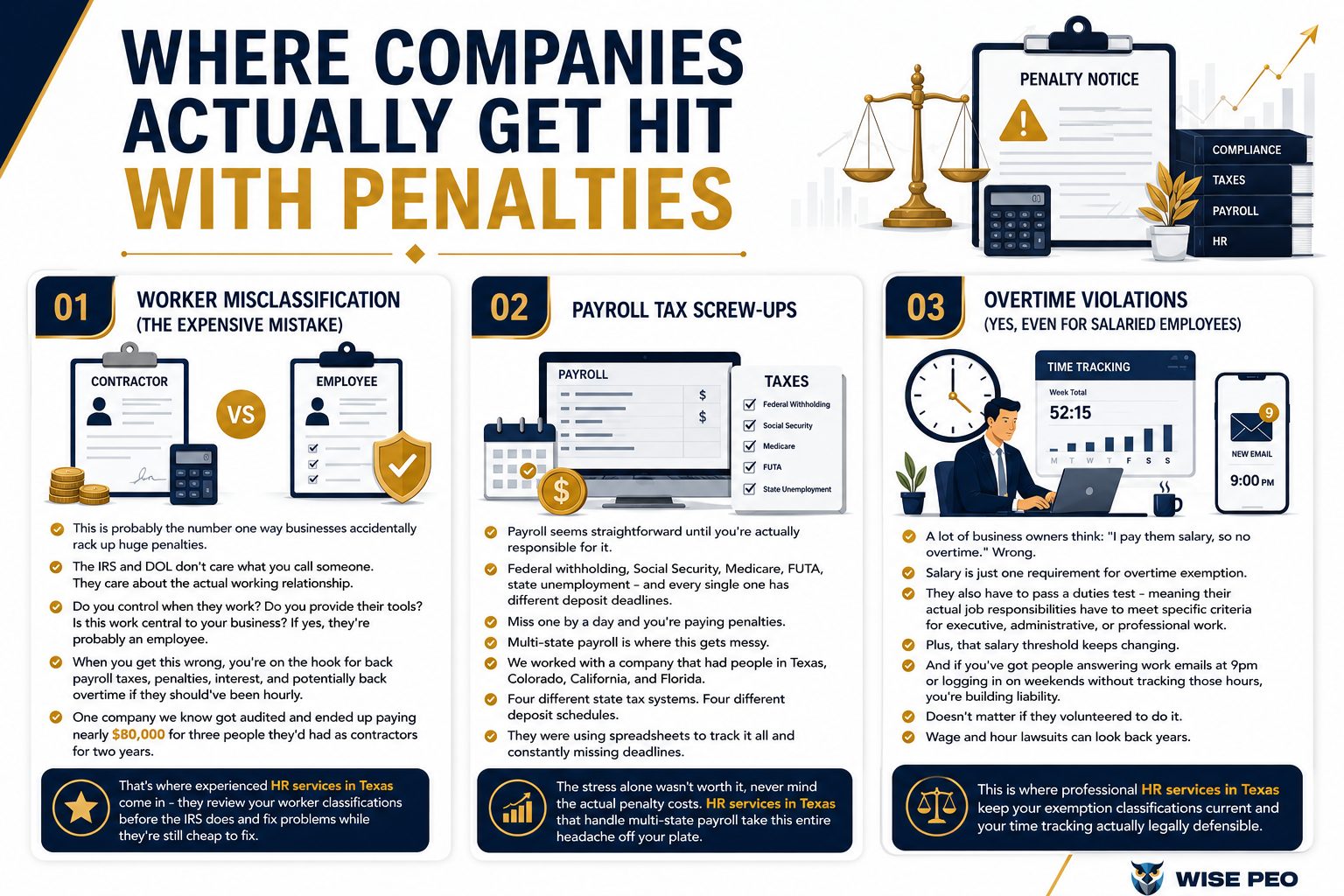
Worker Misclassification (The Expensive Mistake)
This is probably the number one way businesses accidentally rack up huge penalties. You hire someone as a contractor because it seems simpler. No payroll taxes, no benefits, they handle their own stuff. Great, right?
Except the IRS and DOL don’t care what you call someone. They care about the actual working relationship. Do you control when they work? Do you provide their tools? Is this work central to your business? If yes, they’re probably an employee, and calling them a contractor doesn’t change that.
When you get this wrong, you’re on the hook for back payroll taxes, penalties, interest, and potentially back overtime if they should’ve been hourly. One company we know got audited and ended up paying nearly $80,000 for three people they’d had as contractors for two years. That’s where experienced HR services in Texas come in – they review your worker classifications before the IRS does and fix problems while they’re still cheap to fix.
Payroll Tax Screw-Ups
Payroll seems straightforward until you’re actually responsible for it. Federal withholding, Social Security, Medicare, FUTA, state unemployment – and every single one has different deposit deadlines. Miss one by a day and you’re paying penalties.
Multi-state payroll is where this gets messy. We worked with a company that had people in Texas, Colorado, California, and Florida. Four different state tax systems. Four different deposit schedules. They were using spreadsheets to track it all and constantly missing deadlines. The stress alone wasn’t worth it, never mind the actual penalty costs. HR services in Texas that handle multi-state payroll take this entire headache off your plate.
Overtime Violations (Yes, Even for Salaried Employees)
A lot of business owners think: “I pay them salary, so no overtime.” Wrong. Salary is just one requirement for overtime exemption. They also have to pass a duties test – meaning their actual job responsibilities have to meet specific criteria for executive, administrative, or professional work.
Plus, that salary threshold keeps changing. What qualified as exempt in 2023 might not in 2026. And if you’ve got people answering work emails at 9pm or logging in on weekends without tracking those hours, you’re building liability. Doesn’t matter if they volunteered to do it. Wage and hour lawsuits can look back years. This is where professional HR services in Texas keep your exemption classifications current and your time tracking actually legally defensible.
I-9 Forms (Harder Than They Look)
The I-9 form is three pages and seems pretty simple. ICE has about 20 different ways to find errors: wrong documents accepted, Section 2 completed too late, signatures missing, dates in the wrong format, forms not kept for the required three years.
Penalties start at hundreds of dollars per form. If you’ve got 40 employees and 20 bad I-9s, that’s potentially tens of thousands in fines. First-time violation? Doesn’t matter. The penalties still hit. HR services in Texas that know ICE audit procedures can review your I-9s and fix issues before an audit happens.
Leave Laws (Federal Plus Whatever State You’re In)
FMLA covers companies with 50+ employees for unpaid medical and family leave. But then states decided to create their own paid leave programs. California has one. New York has one. Washington. New Jersey. Texas doesn’t, but if you’ve got remote workers in those states, their state rules still apply to you.
The mistakes we see: denying valid FMLA requests because someone didn’t understand intermittent leave works. Retaliating (without meaning to) by not promoting someone who just got back from leave. Managing multi-state leave requirements without realizing different states have completely different eligibility rules. If you’re a Texas employer with remote workers in California or New York, you’re dealing with their paid leave laws too. Professional HR services in Texas with national reach handle all this complexity so you don’t accidentally break laws you didn’t even know existed.
Workplace Safety and Workers’ Comp
OSHA doesn’t wait for an accident to show up. They do planned inspections. You need injury logs, safety training records, hazard communication programs. Miss something and the citations add up fast.
Workers’ comp is state-specific, and if you don’t have coverage when someone gets hurt, you’re facing both fines AND a lawsuit. Texas has some industry-specific requirements. Other states have different thresholds for when coverage kicks in. Managing policies across multiple states without professional help? Good luck. That’s exactly why companies use HR services in Texas that handle workers’ comp nationwide – one point of contact instead of juggling five different insurance carriers.
Benefits and ACA Reporting
Hit 50 full-time employees and the ACA kicks in. You have to offer health insurance that meets minimum value, and you have to report it to the IRS. Those 1095-C forms? Yeah, they don’t auto-generate themselves.
Tracking who’s full-time is trickier than it sounds. Variable hour employees, seasonal workers, people who jump between 28 and 32 hours per week – all of this affects your ACA obligations. Then you’ve got COBRA, ERISA if you offer a 401(k), Section 125 cafeteria plans. Benefits administration is basically a full-time compliance job now. That’s why companies across Texas partner with HR services in Texas that handle all the ACA reporting and benefits compliance instead of hiring an entire benefits team.
How We Actually Help
We’re not trying to scare you with everything that can go wrong. But this stuff is our daily work, and we’ve seen what happens when companies try to DIY their compliance.
At Wise PEO, we work through a co-employment model. You run your business and manage your people. We become the employer of record for tax and insurance purposes. That means we handle payroll, tax deposits, workers’ comp, benefits admin – all the compliance-heavy stuff that takes time away from actually running your company.
Our team tracks employment law changes in all 50 states. When the DOL updates overtime rules or California passes a new leave law, we update our systems and let you know how it affects your people. You don’t need to subscribe to five different compliance newsletters or attend webinars about regulatory changes.
If you’re operating in Texas, our HR services in Texas include people who actually know Texas-specific requirements. How state unemployment works. What wage payment laws require. How Texas workers’ comp differs from other states. But we’re not Texas-only. If you expand to another state tomorrow, we’re already set up there. Our HR services scale with how you grow.
We also give your employees direct access to tools and support. Need to update an I-9? There’s a portal. Questions about whether they qualify for FMLA? Our HR team answers that. It’s not just about avoiding penalties – though that’s important. It’s about building HR systems that actually work instead of creating more headaches.
Don’t Do These Things
Using a Three-Year-Old Employee Handbook
That handbook you wrote in 2021? Probably outdated. Laws changed. Court decisions happened. What was compliant then might not be now. You can’t just set it and forget it.
Thinking All States Work Like Your State
California’s meal break laws don’t apply in Texas. Texas’s at-will employment rules don’t override New York’s paid sick leave requirements. Every state where you have an employee is a different compliance obligation. Pretending otherwise gets expensive.
Assuming Software Handles Compliance
Payroll software is useful. It won’t catch that you misclassified someone as exempt. Your ATS won’t tell you that job posting violates the ADA. Technology helps. It doesn’t replace actually knowing what you’re doing. Good HR services combine the technology with people who understand employment law.
Ignoring Small Problems Until They’re Big Problems
One person occasionally working through lunch seems minor. Until it’s 10 people doing it regularly and someone files a wage claim for the whole group. Small compliance gaps compound. Fix them when they’re small.
Start Here If You’re Fixing Your Compliance
Getting compliant doesn’t happen overnight, but you can work through it systematically:
1. Audit what you’ve got now. Look at your payroll process, your job classifications, your recordkeeping, your benefits. Write down where you have gaps or where you’re not sure if you’re doing it right.
2. Update your policies. Get your employee handbook current with 2026 laws. If you operate in multiple states, you might need state-specific addendums because one policy document can’t cover all the variations.
3. Check every single job classification. Go through each role. Make sure exempt/non-exempt designations are actually correct. Verify that contractors pass the legal tests for independent contractor status.
4. Fix your timekeeping. Whatever system you use – app, badge swipe, manual sheets – make sure it’s capturing all hours worked. Not just shift time. Emails answered after hours. Work done on weekends. All of it.
5. Build a compliance calendar. Every tax deadline. Every benefit reporting requirement. Policy review dates. Required employee notices. Track it all so you’re not scrambling at the last minute.
6. Train your managers. They’re implementing your policies every day. They need to know overtime rules, anti-discrimination basics, when to escalate HR issues. A well-trained manager prevents most problems before they start.
7. Get help where you need it. Maybe that’s an employment attorney. Maybe you hire an HR person. Maybe you work with a PEO. Figure out what you can actually handle yourself and what needs expert support.
When It Makes Sense to Talk to Us
You might be reading this thinking “do I actually need a PEO?” Fair question. Here’s when it usually makes sense:
- You’re spending more time on HR stuff than on growing your business
- You’ve got people in multiple states and compliance is getting messy
- You received a notice from the DOL, IRS, or state agency and you’re not totally sure how to handle it
- Your payroll company can’t keep up with your growth or multi-state needs
- You want to offer real benefits but the admin work seems overwhelming
- You’re genuinely unsure if your current HR practices are legal
We work with companies of all sizes. Startups. Established businesses. Our approach: we talk, we figure out what you actually need, we explain what we can do, and we tell you honestly if it’s a good fit. No pressure. No sales tactics. Whether you need HR services in Texas or nationwide support, we’ll walk you through what makes sense.
You can reach us. We’ll have an actual conversation about your situation, what’s keeping you up at night, and whether working with us would solve those problems. If we’re not the right answer, we’ll tell you that too.
Bottom Line
HR compliance penalties aren’t some unavoidable cost of doing business. They’re preventable. You need the right systems, current knowledge, and either in-house expertise or outside support from people who actually know this stuff.
Laws will keep changing. The DOL will issue new guidance. States will pass new requirements. You can either spend your time tracking all of that, or you can run your business while someone else handles the compliance piece.
If you want HR services that reduce stress instead of creating more of it, we should talk. Check out wisepeo.com to learn more about what we do with PEO services, payroll, benefits administration, and compliance management. No sales pitch. Just real help when you’re ready for it.
Want to prevent costly HR penalties before they happen? Explore our in-depth Human Resources Outsourcing guide to see how the right HR support can protect and strengthen your business.
Questions People Actually Ask Us
Payroll tax errors, overtime violations, worker misclassification, I-9 issues, and ACA reporting failures. That’s the top five. Penalties range from a few hundred to several thousand per violation, and they multiply fast when the same problem affects multiple employees.
Overtime exemption thresholds got updated again. More states added paid leave requirements. Remote worker classification is under heavier scrutiny. Multi-state compliance got more complicated because states are diverging on employment law instead of staying consistent with federal rules. Plus agencies are doing way more audits than they used to.
We handle the compliance-heavy parts through co-employment. We process payroll and handle tax deposits. We maintain workers’ comp coverage. We administer benefits. We track federal and state employment law changes. We provide expert help when issues come up. Our systems catch problems before they become penalties. You focus on running your business, we handle the HR services that keep you compliant.
Yes. Some rules only apply above certain employee counts, but a lot of compliance applies to everyone. Even with 10 employees, you’re responsible for payroll taxes, wage and hour laws, I-9 forms, and anti-discrimination rules. Small companies actually have more risk proportionally because they usually don’t have dedicated HR people. One mistake costs the same whether you’ve got 10 employees or 100. That’s the whole point of working with professional HR services in Texas – you get enterprise-quality compliance expertise without needing to hire an entire HR department.
When compliance is eating up time you should spend on your actual business. When you’re expanding to multiple states. When you’ve had payroll or tax filing issues. When benefits administration is overwhelming. When you want to reduce risk but can’t afford a full internal HR department. A PEO makes sense when the cost of mistakes exceeds the cost of getting help. For most growing companies, that threshold is earlier than they think.
HR services could mean consulting, training, software – things that help you manage HR yourself. PEO services are a co-employment partnership where we become the employer of record for certain purposes. We don’t just advise, we actually do the work: process payroll, file taxes, provide workers’ comp, handle benefits. It’s a deeper partnership than traditional HR consulting. HR services give you tools and guidance. PEO services share the actual employment responsibilities and liabilities.
Start with an audit. Check your classifications. Review your handbook against current laws. Verify payroll tax deposits are timely and accurate. Make sure I-9 forms are complete and stored properly. Confirm benefits meet legal requirements. If you find gaps or you’re not sure about something, that’s when you bring in help – employment attorney, internal HR staff, or professional HR services that can provide ongoing compliance support instead of just pointing out problems.
Texas is at-will with fewer state regulations than places like California or New York. Federal laws still apply fully though. No state income tax affects how payroll works. Specific requirements around final paychecks, unemployment insurance, and workers’ comp. If you’ve got employees both in Texas and other states, you’re juggling different rules for each location. That’s where experienced HR services in Texas with multi-state capabilities become really valuable – they know both Texas-specific requirements and how to handle employees in other states simultaneously.