
Most business owners handle their own HR until something breaks. A payroll mistake. A benefit question they can’t answer. An employee asks about FMLA and they’re not even sure what that means.
The question isn’t if you’ll need help with HR services. It’s when.
At Wise PEO, we work with growing Texas businesses that have hit that wall. You’re doing fine with basic payroll, but suddenly you’re hiring in three states. Your top candidate just asked about your 401(k) match and you don’t have one. The IRS sent a letter about worker classification.
This guide covers when outsourcing makes sense, what you actually get, and how to pick the right partner.
Why HR Got More Complicated in 2026
Five years ago, you could run payroll through QuickBooks and call it done. Not anymore.
The Department of Labor keeps changing overtime rules. Half the states rolled out paid sick leave programs. Texas updated workers’ comp requirements for certain industries. Employee classification rules got stricter.
Then there’s multi-state work. Your developer moved to Colorado. Your sales rep is in Arizona. Suddenly you’re filing payroll taxes in three states and you’re supposed to know each state’s meal break laws.
HR compliance for small businesses used to mean posting a few notices and filing quarterly taxes. Now it means tracking regulation changes across multiple jurisdictions, understanding co-employment laws, and hoping you classified everyone correctly.
That’s why HR outsourcing services exist. Not because you’re doing it wrong. Because it got genuinely hard.
When Should a Company Outsource HR?
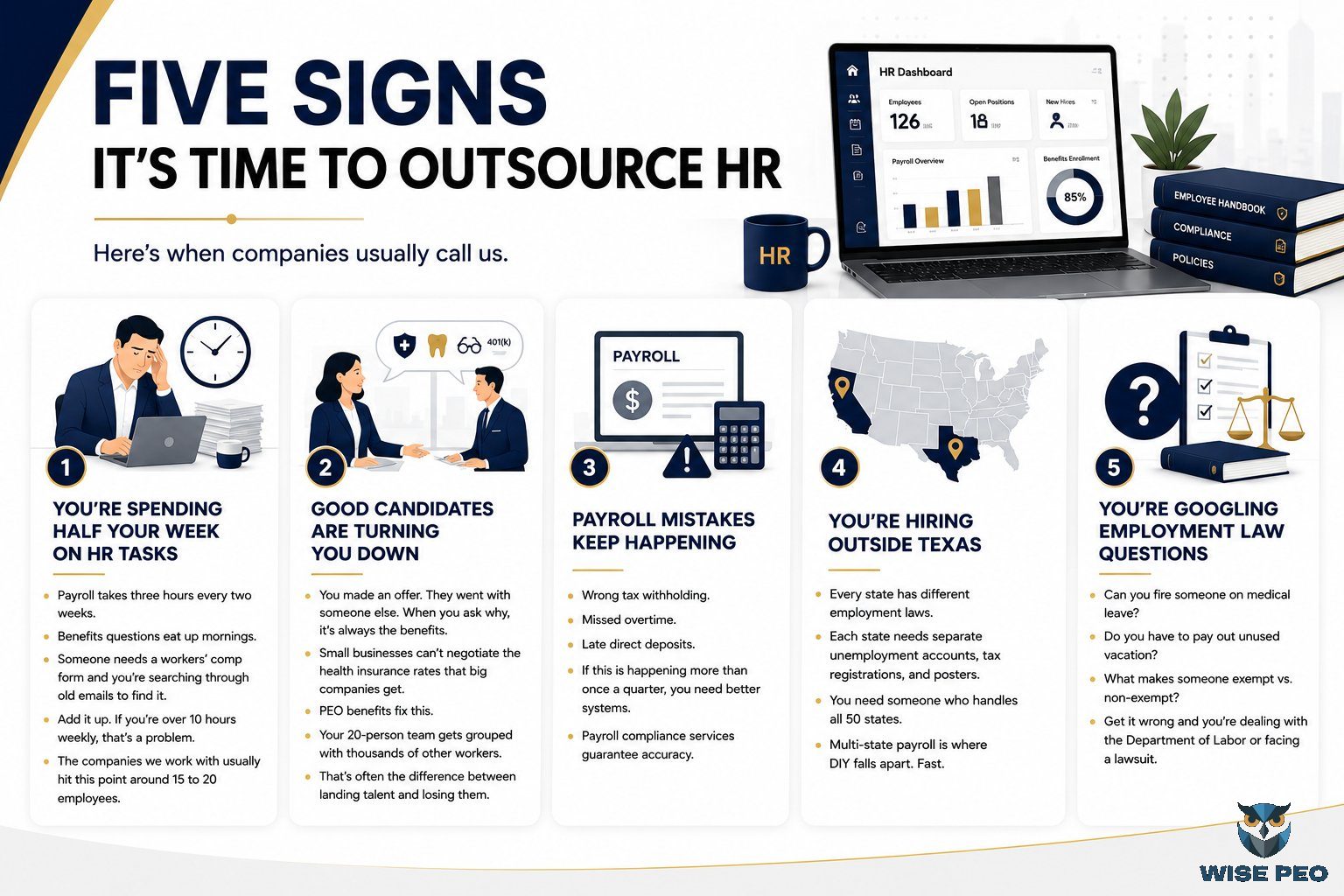
Five Signs It’s Time to Outsource HR
Here’s when companies usually call us.
- You’re Spending Half Your Week on HR Tasks
Payroll takes three hours every two weeks. Benefits questions eat up mornings. Someone needs a workers’ comp form and you’re searching through old emails to find it.
Add it up. If you’re over 10 hours weekly, that’s a problem. You’re probably worth more than what you’d pay for HR outsourcing services, and you’re definitely better at running your actual business than managing payroll compliance.
The companies we work with usually hit this point around 15 to 20 employees. Below that, you can manage. Above it, HR becomes a second job nobody wants.
- Good Candidates Are Turning You Down
You made an offer. They went with someone else. When you ask why, it’s always the benefits.
Small businesses can’t negotiate the health insurance rates that big companies get. You’re stuck paying more for worse coverage. No 401(k) matching. No dental. No vision. Candidates notice.
PEO benefits fix this. We pool employees from all our client companies. Your 20-person team gets grouped with thousands of other workers. Insurance carriers see a big group and offer big company rates.
Your employees get better health insurance, 401(k) options, dental, vision, life insurance. Same benefits a Fortune 500 company offers. That’s often the difference between landing talent and losing them.
- Payroll Mistakes Keep Happening
Wrong tax withholding. Missed overtime. Late direct deposits. Each mistake costs you trust with your team.
Payroll compliance services guarantee accuracy because they process thousands of paychecks. They have systems to catch errors before money moves. And if they mess up, they cover the penalties.
When you’re handling payroll yourself or through basic software, mistakes happen. Garnishment orders get missed. Multi-state tax calculations go wrong. Someone keys in the wrong Social Security number.
If this is happening more than once a quarter, you need better systems.
- You’re Hiring Outside Texas
Texas is straightforward. You know the rules. Then you hire someone in California and realize every state has different employment laws.
California has mandatory meal breaks. New York has paid family leave. Each state needs separate unemployment accounts, tax registrations, and workplace posters. Some cities have their own minimum wage.
HR services in Texas won’t help you there. You need someone who handles all 50 states. We register you everywhere you have employees, file the right taxes, and keep you compliant with local rules.
Multi-state payroll is where DIY falls apart. Fast.
- You’re Googling Employment Law Questions
Can you fire someone on medical leave? Do you have to pay out unused vacation? What makes someone exempt vs. non-exempt?
These aren’t simple questions. The answers depend on federal law, state law, sometimes local law. Get it wrong and you’re dealing with the Department of Labor or facing a lawsuit.
When you outsource HR, you get people who answer these questions every day. They know employment law. They’ve handled hundreds of terminations, FMLA requests, and discrimination complaints.
You call. They answer. You make the right decision instead of guessing based on what you found on a legal forum.
Need help deciding if HR outsourcing is right for your business? Read our complete guide: Human Resources Outsourcing: Complete Guide for Growing Businesses
What HR Outsourcing Actually Includes
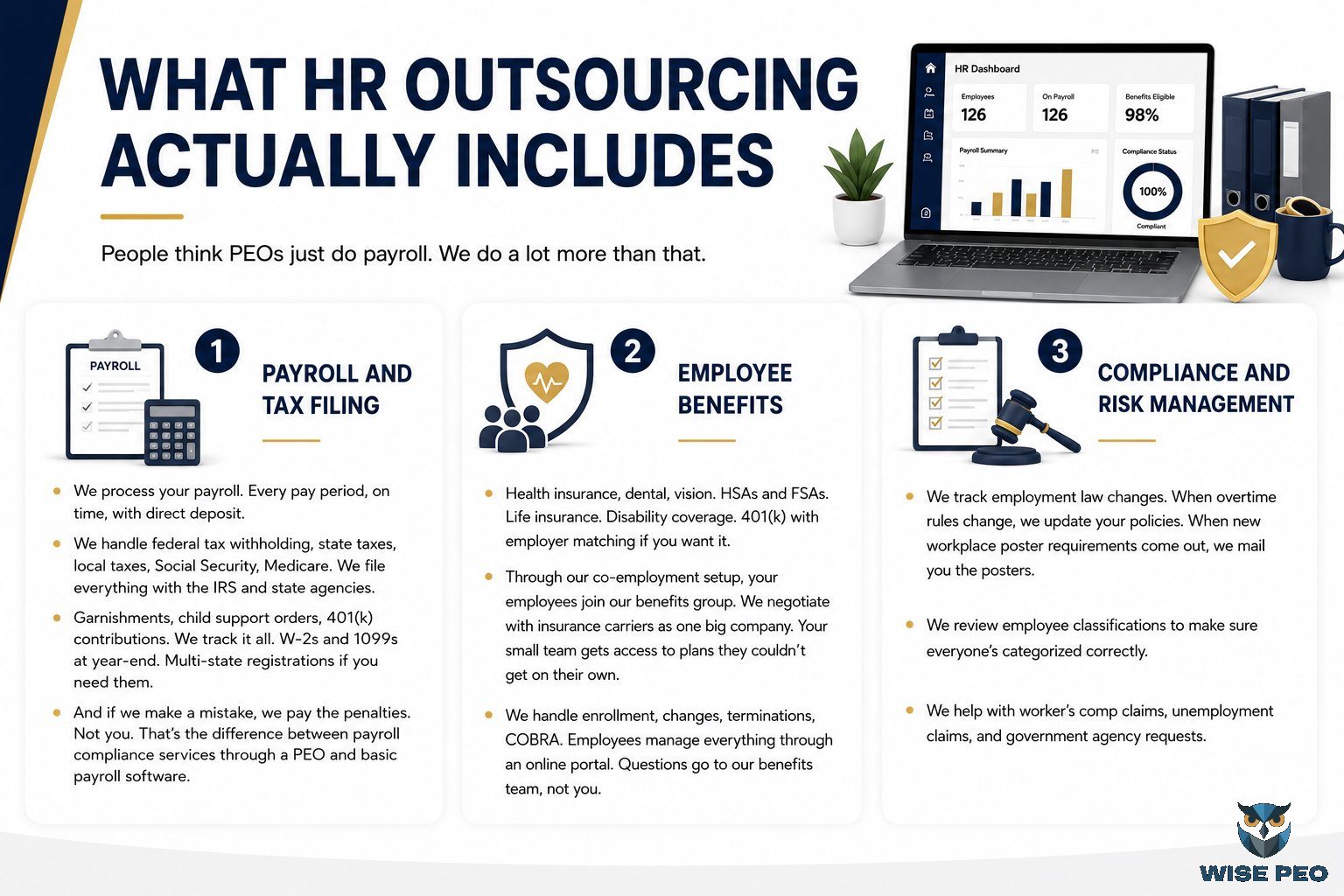
People think PEOs just do payroll. We do a lot more than that.
- Payroll and Tax Filing
We process your payroll. Every pay period, on time, with direct deposit. We handle federal tax withholding, state taxes, local taxes, Social Security, Medicare. We file everything with the IRS and state agencies.
Garnishments, child support orders, 401(k) contributions. We track it all. W-2s and 1099s at year-end. Multi-state registrations if you need them.
And if we make a mistake, we pay the penalties. Not you. That’s the difference between payroll compliance services through a PEO and basic payroll software.
- Employee Benefits
Health insurance, dental, vision. HSAs and FSAs. Life insurance. Disability coverage. 401(k) with employer matching if you want it.
Through our co-employment setup, your employees join our benefits group. We negotiate with insurance carriers as one big company. Your small team gets access to plans they couldn’t get on their own.
We handle enrollment, changes, terminations, COBRA. Employees manage everything through an online portal. Questions go to our benefits team, not you.
- Compliance and Risk Management
We track employment law changes. When overtime rules change, we update your policies. When new workplace poster requirements come out, we mail you the posters.
We review employee classifications to make sure everyone’s categorized correctly. We help with worker’s comp claims, unemployment claims, and government agency requests.
HR compliance for small business means somebody’s watching the laws so you don’t have to. We do that.
HR Support When You Need It
The employee wants FMLA leave. You’re not sure how to handle a performance issue. Someone filed a harassment complaint.
You call us. We walk you through it. We help you document properly, follow the right process, and avoid legal problems.
It’s like having an HR department without hiring one.
Three Mistakes to Avoid
- Waiting Until You’re in Trouble
Don’t wait for the audit, the lawsuit, or the penalty notice. By then you’re making decisions under pressure and you’ll probably rush the process.
Outsource when things are stable. You’ll have time to pick the right provider, implement properly, and get it done right.
- Just Picking the Cheapest Option
Cheap payroll services exist. They process paychecks and that’s it. No benefits. No compliance help. No protection when things go wrong.
Look at the total value. A PEO might cost more monthly, but you’re getting better benefits (which saves money), compliance protection (which prevents expensive mistakes), and your time back (which is worth something).
The cheapest option usually costs more in the long run.
- Not Testing the Technology
Your employees will use these systems daily. Clunky software means constant complaints and calls to you for help.
Ask for demos. Log in yourself. Try to request time off. Check a pay stub. See if it works on your phone.
If the demo feels complicated, your team will hate it. Keep looking.
How to Pick the Right Provider
- Here’s what actually matters when you’re evaluating HR outsourcing services.
- 1. Figure out what you need. Write down every HR task you’re doing now. Track how much time it takes. This becomes your baseline for measuring improvement.
- 2. Get detailed pricing. Not estimates. Actual line-item breakdowns. Implementation fees, monthly costs per employee, benefit charges, workers’ comp rates, technology fees. Hidden fees kill budgets.
- 3. Test their platform. Most providers will give you demo access. Use it like you’re an employee. Can you find your pay stub? Request time off? Update your address? If it’s confusing in the demo, it’ll be worse in real life.
- 4. Talk to their current clients. Ask what broke during implementation. What costs more than quoted. How long it takes to get help when something goes wrong.
- 5. Read the contract. Pay attention to termination clauses and fee increases. Some PEOs lock you in with penalties if you leave early.
- 6. Understand the implementation timeline. Switching payroll and benefits mid-year is messy. Good providers plan this carefully. Bad ones wing it and create chaos.
When Wise PEO Makes Sense
We work best with companies in a few specific situations.
You’re based in Texas but growing into other states. We know Texas employment law inside and out, but we also handle the complexity of multi-state operations without making you become an expert in 50 different regulatory systems.
You have between 10 and 200 employees. Below 10, you can probably manage on your own. Above 200, you might need a dedicated internal HR team. That middle range is where we add the most value.
You’re losing candidates because of benefits. If good people are choosing other companies because they offer better health insurance or 401(k) matching, PEO benefits solve that problem.
Your leadership team is buried in HR tasks. If you’re spending hours every week on payroll, benefits questions, and compliance issues, we take that off your plate.
You want more than just payroll processing. Basic payroll services are cheaper than PEOs. But if you need benefits, compliance support, and HR expertise, a PEO delivers all of that in one package.
The Bottom Line
You didn’t start a business to become an HR expert. You started it to sell your product, serve your customers, and build something.
HR matters. Payroll has to be right. Benefits need to be competitive. Compliance isn’t optional. But none of that requires you to do it yourself.
For most growing companies, the shift happens somewhere between 15 and 30 employees. That’s when HR stops being manageable and starts being a problem. The complexity jumps. The risk increases. The time investment becomes unreasonable.
At Wise PEO, we handle the HR infrastructure so you can focus on running your business. We process payroll, manage benefits, keep you compliant, and answer questions when they come up.
If you’re spending too much time on HR, losing talent to companies with better benefits, or worried about compliance mistakes, it’s worth having a conversation.
Contact Wise PEO to discuss your situation. Visit wisepeo.com or call us to talk through whether HR outsourcing makes sense for your business.
Still evaluating your options? Our pillar page breaks down everything you need to know about HR outsourcing: Human Resources Outsourcing: Complete Guide for Growing Businesses
Common Questions
Payroll software processes paychecks. That’s it. You’re still handling benefits yourself, tracking compliance yourself, and dealing with employee questions yourself. A PEO does payroll plus benefits administration, compliance management, workers’ comp, unemployment insurance, and HR support. It’s a different category of service.
We become the employer of record for benefits and tax purposes through co-employment. Your employees technically work for both your company and the PEO. This lets us pool all our client employees into one large group for insurance. Insurance carriers give better rates to bigger groups, so your small team gets big company pricing. You still control everything about how they work, what they do, and when they do it.
No. You hire them, fire them, set their pay, assign their work, and manage their day-to-day. The PEO handles the administrative stuff in the background. Co-employment is an administrative relationship, not an operational one. They’re your employees, working for your business, under your direction.
It means following employment laws. Federal laws like the Fair Labor Standards Act (overtime rules), FMLA (medical leave), and ADA (disability accommodations). State laws that vary everywhere. Tax withholding and payments. Workplace safety rules. Proper employee classification. Required posters. For small businesses, it’s hard because you’re subject to the same rules as big companies but you don’t have dedicated compliance staff.
Yes, but you’re missing most of the value. Payroll-only services cost less than PEOs. But you’re still managing benefits, compliance, workers’ comp, and employee relations yourself. Most companies that start payroll-only end up switching to full HR outsourcing services within a year or two because they realize the other stuff is where the real problems are.
Specialized software with built-in tax tables and error checking. Experienced processors who handle thousands of paychecks. Quality control systems that catch problems before money moves. And most importantly, we guarantee our work. If we make a mistake that causes penalties, we pay them. You don’t.
Usually 4 to 8 weeks depending on complexity. Simple situations (one state, basic benefits) can happen faster. Multi-state operations with complex benefits take longer. The timeline depends partly on your current benefit renewal dates, since we try to time the switch to avoid coverage gaps.
Texas has specific employment considerations. Workers’ comp is optional here but recommended. The unemployment tax system works differently than other states. Certain industries have unique requirements. But the bigger issue is that Texas businesses often expand to other states, and that’s where complexity explodes. You need someone who knows Texas but can also handle California, New York, Florida, or wherever you’re growing.